
Freedom of Expression in the Masculine. On a power structure in Lebanon that debates women instead of debating what they say.
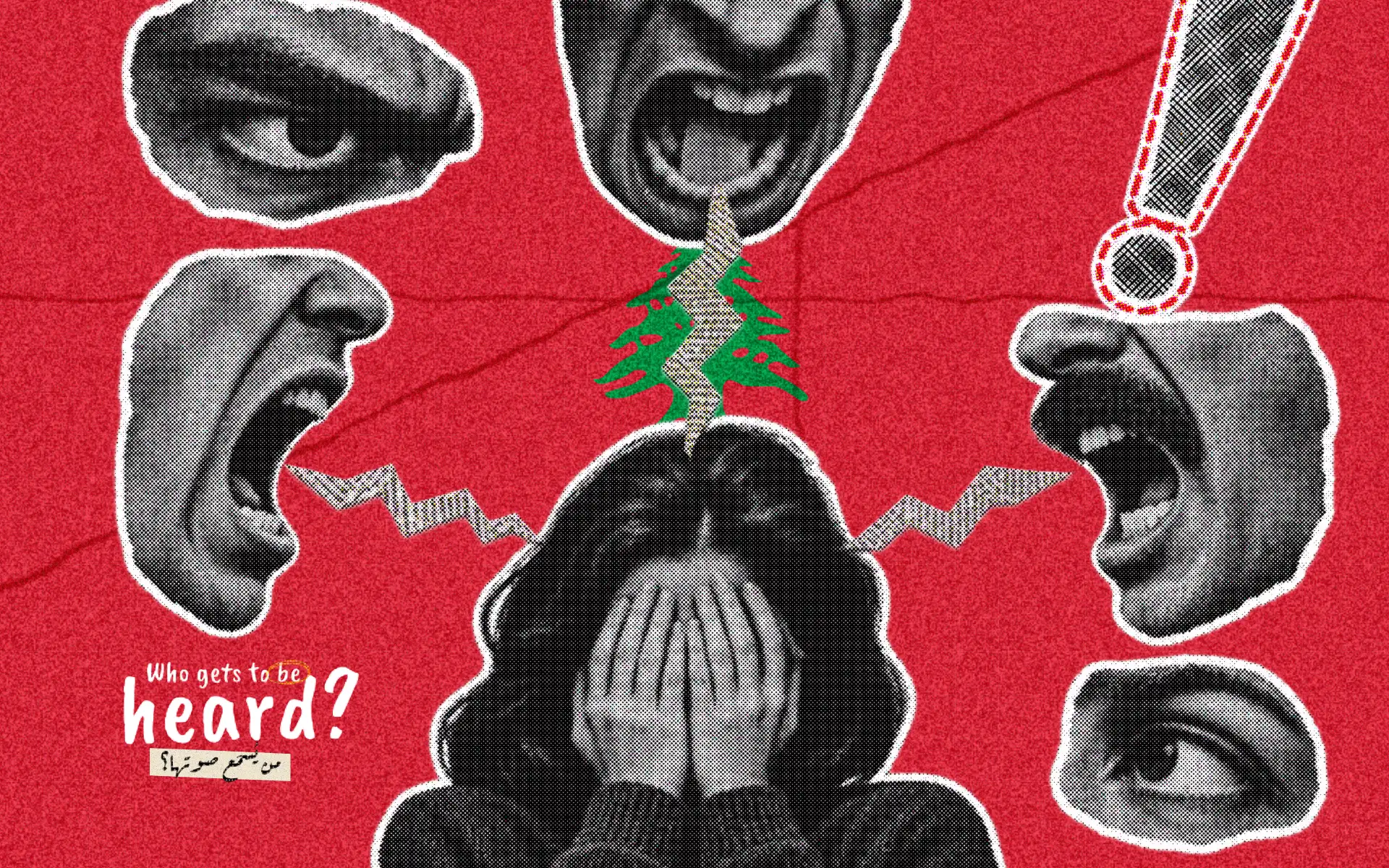
“Sit down, wait until the end, and be quiet.” With these words, Speaker of Parliament Nabih Berri answered MP Halima Kaakour during a legislative session on 26 July 2022. Kaakour had objected to the voting procedure after she was unable to tell who had voted for one of the items and who had voted against it, and she demanded transparency in parliamentary procedure. She responded by denouncing the “patriarchal manner” in which she was being treated.
MP Farid Haykal al-Khazen objected to the word, taking it as a reference to the Patriarch and the patriarchal see, and asked for it to be struck from the session record. Berri agreed. Kaakour had meant the paternalistic mindset and male authority, but the debate turned to the word itself. Her question about the transparency of the vote, a question that touches citizens’ right to know how their representatives vote, was never taken up again. And so the MP’s word was struck from the record, while the order to keep quiet remained in it.
In the same session, MP Qabalan Qabalan mocked MP Cynthia Zarazir’s family name, calling her “cockroaches” (sarasir). Zarazir later said that since entering parliament she had faced harassment, including inappropriate comments and conduct of a sexual nature inside her parliamentary office.
Earlier, in October 2019, then-Minister of the Displaced Ghassan Atallah accused MP Paula Yacoubian, during a televised exchange, of having reached parliament “in an immoral way.” She condemned the resort to questioning her honour whenever she criticised political performance: “Honour is not between the legs, it is in the head, and that is something you don’t have.”
Three MPs, three political objections, and one outcome: the debate shifted from the substance of what the woman said to the way she spoke, her name, her body, or her “honour.” A male politician is usually debated on his positions, affiliation and performance. A woman, by contrast, finds herself forced to defend her person first, while the issue she raised fades into the background.
This is not merely rude behaviour. It is a real restriction on freedom of expression and on the right to political participation, two rights guaranteed by the Lebanese Constitution and by the international treaties Lebanon has committed to. When a woman pays an extra price for her words because of her sex, freedom of expression is no longer equally available to all. It becomes freedom of expression in the masculine.
Women in Lebanese Politics: Limited Presence, Marginalised Voice
The male dominance of Lebanese political life becomes clear when we look at who holds decision-making positions. Women hold only eight of the 128 seats in parliament, about 6% of its members. This absence extends to television screens: in a monitoring of media coverage of the 2022 elections, women made up only 7% of participants in televised political debates during February and March.
This gap is tied to the structure of the political system itself. Leadership and decision-making positions remain largely governed by family, party and sectarian networks dominated by men. Within this structure, women face obstacles in financing, in access to resources, and in reaching leadership positions within parties, while media institutions determine who appears and who gets to shape public opinion.
A United Nations Development Programme report on violence against women in politics documented Lebanese women’s experiences of this violence and showed how it hinders participation and representation. The phenomenon is not only Lebanese: in a 2016 study by the Inter-Parliamentary Union of women parliamentarians from 39 countries, more than eight in ten said they had experienced psychological violence during their term, and around two-thirds had faced repeated sexist remarks.
But the obstacle does not end once a woman reaches her seat. Another battle begins: how is she allowed to exercise power? She is expected to be strong, but not too strong. To speak with confidence, without seeming harsh. To object, with a politeness that pleases others. And to endure insult without getting angry, because her anger may be used as evidence against her. In a man, the same behaviour is presented as firmness.
The point is not that men are never subjected to political insults. The point is that women face an additional layer of targeting tied to their gender, one that turns the exercise of their right to participate into a constant battle to prove their right to be there at all.
When “Honour” Replaces Argument
In a society that still grants the notion of “honour” great power over women’s lives, a single reference to reputation, personal relationships or appearance can be enough to silence a woman. A hint about her private life, a comment on her clothes, or doubt cast on how she reached her position moves the debate from the public issue to self-defence.
Much of this targeting has moved online. In a monitoring of comments on the accounts of women candidates in the 2022 parliamentary elections, the Maharat Foundation and the Madaniyat association recorded 831 comments involving gender-based violence in the month of April alone. The UN Committee on the Elimination of Discrimination against Women recognises, in its General Recommendation No. 35, that gender-based violence includes violence carried out through technology, and is not limited to physical harm.
The effects of this targeting do not stop at the women directly subjected to it. Fear of defamation may push other women to hesitate before running for office, to reduce their presence in public debate, or to censor what they say. This is what makes violence against women in politics a freedom of expression issue par excellence: it does not harm only the victim, it sends a message to every woman thinking of speaking in public.
What Does the Law Say?
A woman’s right to be heard does not rest on good intentions. It rests on texts that bind Lebanon.
In the Constitution. Article 7 provides that all Lebanese are equal in civil and political rights, and Article 13 guarantees freedom of opinion in speech and writing, freedom of assembly and freedom of association, within the limits of the law. Paragraph (b) of the Constitution’s preamble affirms Lebanon’s commitment to the covenants of the United Nations and the Universal Declaration of Human Rights, and to embodying these principles in all fields without exception.
In the International Covenant on Civil and Political Rights, to which Lebanon acceded in 1972. Article 19 protects freedom of expression, Article 25 guarantees every citizen’s right to take part in the conduct of public affairs, and Articles 3 and 26 prohibit discrimination on the basis of sex. In its General Comment No. 25, the Human Rights Committee makes clear that political participation requires that citizens be able to exercise it free from fear and intimidation.
In the Convention on the Elimination of All Forms of Discrimination against Women (CEDAW), to which Lebanon acceded in 1997. Article 7 obliges the state to take appropriate measures to eliminate discrimination against women in political and public life, and Lebanon entered no reservation to it. Article 4 permits temporary special measures to accelerate de facto equality, as the Committee elaborated in its General Recommendations No. 23 on political and public life and No. 25 on temporary special measures. The UN Special Rapporteur on violence against women devoted her 2018 report to the General Assembly to violence against women in politics, and called on parliaments to adopt codes of conduct and internal complaint mechanisms.
In Lebanese law. Law No. 205 of 2020 criminalises sexual harassment, including in the workplace, and imposes heavier penalties when it occurs within a relationship of dependency or employment. Its provisions apply to MPs’ offices as to any other workplace.
But here a fundamental gap appears. Article 39 of the Constitution provides that no criminal proceedings may be brought against any MP for opinions and ideas expressed during their term. This immunity was designed to protect MPs’ freedom to hold power to account, and it is a necessary safeguard. In practice, however, it means that an insult directed at a woman MP from the floor of parliament remains beyond the reach of the courts. This is precisely why parliament needs internal rules of conduct and accountability mechanisms: if immunity protects what an MP says, who protects a woman MP’s right to speak?
This is not a call to criminalise speech or to expand restrictions on freedom of expression. International standards, particularly the Human Rights Committee’s General Comment No. 34, warn against broad restrictions on expression. The goal is not to silence anyone, but to ensure that silencing women no longer comes at no cost.
Outside Parliament Too: Women Raising Their Voices Without a Title
Political work does not begin at the ballot box, nor does it end at the doors of parliament. In Lebanon, women have fought long battles for rights the authorities were not ready to recognise, without holding any official position.
In 1982, after her husband was abducted during the civil war, Wadad Halawani founded, together with other women, the Committee of the Families of the Kidnapped and Disappeared in Lebanon. At the first marches, security forces tried to stop the women from reaching the Prime Minister’s office and used force to obstruct them, a clear violation of the freedom of peaceful assembly guaranteed by Article 13 of the Constitution and Article 21 of the International Covenant on Civil and Political Rights. For decades, the mothers, wives and sisters of the missing faced official neglect and pressure to close the file.
This struggle contributed to the adoption of Law No. 105 of 2018 on the Missing and Forcibly Disappeared, which enshrined families’ right to know the fate of their loved ones and provided for the establishment of an independent national commission for this purpose. But the law’s adoption was not the end of the road: the commission still faces difficulties with funding and with operating in practice, and thousands of families are still waiting.
This experience reveals the other face of the same problem: when women hold no position, they are asked to be patient. When they do, they are asked to be quiet. Why should a woman need four decades of struggle before her right to know the fate of her husband or son is recognised, instead of institutions taking responsibility for uncovering the truth?
Is a Quota Enough to Break This Ceiling?
Whenever women’s low political participation in Lebanon comes up, the debate returns to a women’s quota. Some see it as a necessary measure to correct a historical imbalance, while others argue that it grants seats on the basis of sex rather than merit. But this objection ignores a basic question: do men reach power today on merit alone? In a system built on sectarian power-sharing and family and party influence, demanding that women alone prove their worth before being allowed in looks like a selective standard.
According to the International IDEA Gender Quotas Database, Lebanon still has no legislated quota for women in parliament, as Electoral Law No. 44 of 2017 contains no such measure. The CEDAW Committee has repeatedly recommended, in its concluding observations on Lebanon, that the country adopt temporary special measures, including quotas. In February 2026, the National Commission for Lebanese Women, together with international partners, discussed a draft law that would reserve 40% of candidacies on electoral lists for women and 33% of parliamentary seats.
A quota does not contradict the principle of equality. Article 4 of CEDAW states explicitly that temporary special measures aimed at accelerating de facto equality are not considered discrimination. And the equality guaranteed by Article 7 of the Constitution is not achieved by applying an equal text to an unequal reality.
A quota is not a magic solution, and on its own it does not guarantee that elected women will be independent or will defend women’s rights. But it opens doors that the existing balance of power has kept shut. Yet reaching a seat does not mean being able to exercise the role freely. What is the value of electing a woman MP if her objections are met with comments about her looks, her name or the way she speaks, instead of a discussion of her position?
Equal political participation therefore requires reforms that go beyond the electoral law:
- Inside parliament: adopt a binding code of conduct within parliament’s internal rules that prohibits harassment and gender-based insults and sets clear disciplinary sanctions, in line with the Inter-Parliamentary Union’s guidelines for parliaments.
- An independent, confidential complaints mechanism to receive and investigate complaints from MPs and staff, independent of the Speaker’s office and the political blocs.
- Apply Law 205/2020 to parliamentary workplaces, so that women MPs and staff can report harassment without fear of retaliation.
- Within parties: open access for women to leadership positions and to the top of electoral lists, not only to symbolic roles.
- In campaign finance: fairer rules on spending and access to resources.
- In the media: commit media institutions to balanced representation of women and to professional codes that reject defamation and gender-based discourse, without this turning into censorship of opinion.
It also requires confronting the social attitude that still treats women’s presence in public life as an exception in need of justification.
Who Gets to Be Heard?
The right to speak is not fulfilled simply by allowing a woman to talk. It is fulfilled when her sex is no longer a reason to diminish the value of her words, when her reputation is not used to knock down her argument, and when she can challenge power without first being asked to defend herself. Between what the Constitution and treaties guarantee and what women live every day, the gap remains wide.
The issue is not giving women a voice. Women speak, protest, organise and have confronted power for decades. The issue is why they still have to fight an extra battle for their words to be taken seriously.
We do not want women to be quieter in order to be heard, tougher in order to endure insult, or to prove more competence in order to have their right to lead recognised. We want a public sphere where ideas are met with ideas, where power is held accountable for its actions, and where a woman’s body, reputation or identity is never used to push her out of the debate. Only then will freedom of expression be freedom for all, not a privilege in the masculine.
Subjects
Media enquiries: info@humena.org
New publications, by email
Concise briefings on new HuMENA research, statements, and advocacy.
Subscribe