
Ahmed
Samir Santawy
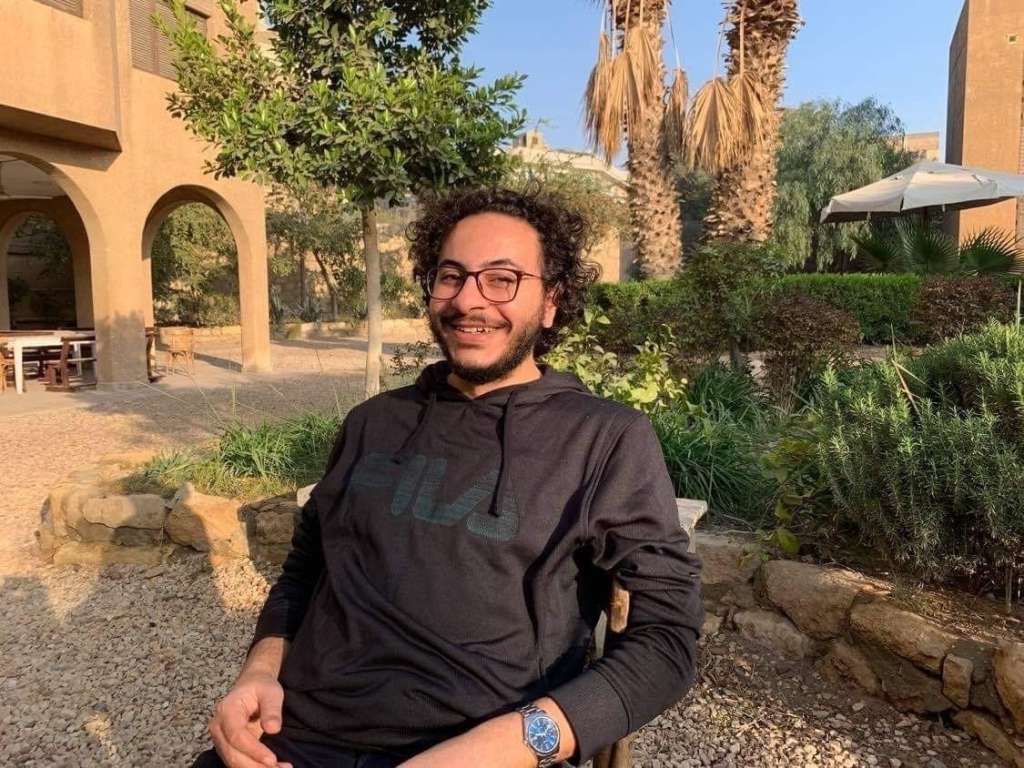
Ahmed Samir Santawy, a graduate student researching women's reproductive rights in Egypt, was sentenced to four years in prison by an emergency court for social media posts, following months of arbitrary detention and ill-treatment. He was released by presidential pardon in July 2022.
- Country
- Egypt
- Role
- Academic / researcher
- Arrested
- 1 Feb 2021
- Sentence
- Four years in prison and a fine of 500 Egyptian pounds (approximately 27 Euros).
- Status
- At liberty
- Arrested
- 1 Feb 2021
- Sentence
- Four years in prison and a fine of 500 Egyptian pounds (approximately 27 Euros).
- Judicial status
- Pardoned
- Restrictions
- Travel ban
- Name in Arabic
- أحمد سمير سنطاوي
- Charges
- Joining a terrorist organization
- Deliberately spreading false news and data
- Using a social media account to spread false news
- Funding a terrorist organization
- Spreading false news from outside the country about the internal situation
The cases, as we document them.
Where a case was replaced by a new one, the two are linked.
- Case65/2021
Defendant
State Security Prosecution
- Case774/2021
Defendant
Supreme State Security Prosecution
The arrest, and what followed.
Update, 13 May 2026: Santawy was released by presidential pardon on 30 July 2022. A travel ban imposed in August 2022 stopped him from returning to Vienna, and he completed his master's degree remotely in September 2023. In April 2026 the Supreme Administrative Court annulled that ban, but on 16 April 2026 the Public Prosecution imposed a new one.
Background and Academic Work
Ahmed Samir Santawy was enrolled in the master's program in Sociology and Social Anthropology at the Central European University in Vienna at the time of his arrest. His research centered on women's reproductive rights in Egypt, with particular attention to the history of access to safe and legal medical treatment. His work examined how legal frameworks and health policy affect women's autonomy and survival, documenting the barriers women face in obtaining reproductive healthcare.
Ahmed's scholarship placed him within a field of study that Egyptian authorities have increasingly treated with suspicion. Research on gender, rights, and civil society has become grounds for surveillance and prosecution, particularly when conducted by students with international academic affiliations. Ahmed was one of several researchers and students targeted in recent years under vague national-security pretexts.
Arrest and Enforced Disappearance
Ahmed was arrested on 1 February 2021 during a visit to Egypt. He was held incommunicado until 6 February 2021. No information about his whereabouts or legal status reached his family or legal representatives during that period. On 6 February 2021, he was brought before the State Security Prosecutor and formally charged in Case 65/2021. The charges included joining a terrorist organization, deliberately spreading false news, and using a social media account to disseminate false information. The prosecution's evidence consisted of screenshots from a Facebook account it claimed belonged to Ahmed.
Ahmed was remanded to pre-trial detention and transferred to Liman Tora Prison, south of Cairo, on the same day. During his initial hearing on 6 February, he reported to the prosecutor that he had been subjected to ill-treatment during interrogation on 1 February. He described the detention conditions at Liman Tora as very poor.
Additional Charges and Emergency Trial
On 23 February 2021, the Supreme State Security Prosecution brought an additional charge against Ahmed: funding a terrorist organization. The prosecution cited alleged new evidence obtained from the National Security Agency. During this hearing, Ahmed again reported the ill-treatment he had suffered and the severe conditions of his detention.
On 22 May 2021, the Supreme State Security Prosecution opened a second criminal investigation against Ahmed under Case 774/2021. This case was based on social media posts the authorities alleged he had written from outside Egypt about the country's internal situation. The new charge was "spreading false news from outside the country about the internal situation."
On 22 June 2021, the Misdemeanours Emergency State Security Court convicted Ahmed and sentenced him to four years in prison and a fine of 500 Egyptian pounds. Emergency court verdicts in Egypt are not subject to appeal and take effect immediately upon presidential signature. The following day, 23 June 2021, Ahmed began a hunger strike in Liman Tora Prison to protest the sentence.
Legal Process and Violations
Ahmed's prosecution illustrates the systematic use of counter-terrorism and national-security charges to silence academic inquiry and critical expression. The charges against him, joining and funding a terrorist organization, spreading false news, are standard formulations used against journalists, researchers, activists, and students. The evidence presented consisted entirely of social media content, a pattern repeated across dozens of similar cases.
The use of an emergency state security court foreclosed any possibility of appeal. Emergency courts in Egypt operate outside the ordinary judicial system and deny defendants fundamental fair-trial guarantees. Ahmed's trial and sentencing took place while he remained in prolonged pre-trial detention, a practice Egyptian prosecutors routinely employ to punish defendants before conviction.
Ahmed's reports of ill-treatment during interrogation and poor detention conditions are consistent with documented patterns in Egypt's national-security detention facilities. Liman Tora Prison, part of the sprawling Tora complex, is known for overcrowding, inadequate medical care, and denial of family visits.
Context and Pattern
Ahmed Samir Santawy is not the only international student Egypt has detained on national-security grounds. On 7 February 2020, Patrick Zaki, a master's student at the University of Bologna and a researcher with the Egyptian Initiative for Personal Rights, was arrested at Cairo airport upon his return from Italy. Patrick was allegedly tortured during interrogation and was held in pre-trial detention in Tora Prison. His case, like Ahmed's, involves charges of spreading false news and incitement, based on his academic work and online expression.
The targeting of international students reflects a broader climate in which Egypt's security services treat foreign academic affiliation, human rights research, and critical scholarship as inherently suspect. Students returning home for visits, researchers conducting fieldwork, and academics corresponding with Egyptian colleagues have all faced arrest, interrogation, and prolonged detention. The pattern suggests a deliberate policy to sever Egypt's academic and civil society communities from international networks.