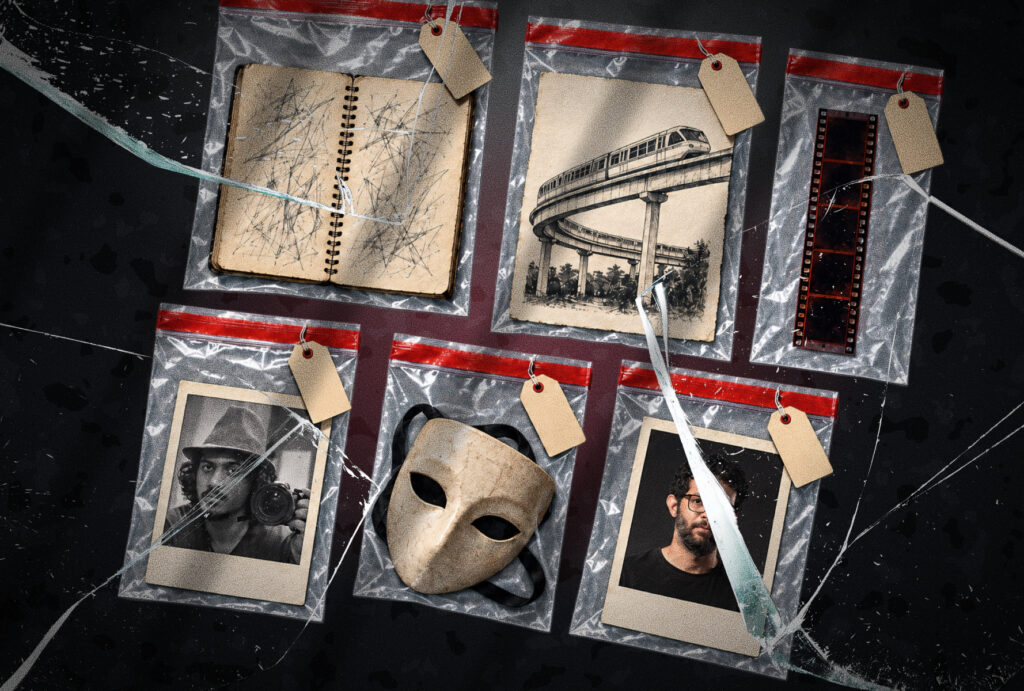
While artists should be engaging with the public sphere with their creative minds, in Egypt, artists remain in prison In this context, it is crucial to define artivism. Artivism is the means to use art for social and political change. It is an attempt from the artists to engage with the public sphere through creative endeavors. In Egypt, artivism is penalized and several artists are being prosecuted for crimes of publishing false news, which is contrary to Article 71 of the constitution which bars custodial penalties for publication offences.
This pattern is most evident following the decision of renewing the detention of the filmmaker and director Omar Salah Marei for 45 days on the 28th of September. This happened following ten consecutive detention renewals for nearly four months of pre-trial detention as he was detained on the 11th of May 2026. In a similar pattern the cartoonist Ashraf Omar’s trial is expected to take place on the 12th of October, as it was postponed to that day in July. Ashraf Omar is being charged with financing a terrorist group and participating in achieving its goals. Both cases are clear examples of penalizing artivism through applying terrorim-related charges for artists engaging with the public sphere. The penalization comes in the form of prolonged arbitrary pre-trial detention for months, and in the case of Ashraf Omar, his detention has been lasting for years. In this manner, artivisim is silenced, with no need from the prosecution to handle evidence-based proofs for their detention except their artworks and activism.
This article overviews seven cases of arbitrary detention of artists. varying between the poet Galal Al-behiary, the cartoonist Ashraf Omar, the actor Hassan El-Sayed, the writer Hani Sobhi, the poet Ahmed Douma, the novelist Peter Tawfik, and the filmmaker Omar Marei.
The seven cases share a set of legal and procedural mechanisms. In most of them, the charges do not name artistic or literary expression as the offence. The poem, cartoon, film role or novel enters the case file as evidence of a separate crime, usually terrorism, false news or contempt of religion. As a result, the creative work never has to be addressed as creative work, and the protections that Egyptian and international law attach to artistic and literary expression are left aside.
The most serious of these mechanisms is the use of terrorism charges. Galal El‑Behairy was first tried before a military court in 2018 over his poetry collection The Finest Women on Earth and his lyrics for Ramy Essam’s song “Balaha.” He is now on trial before the Second Terrorism Circuit of the Cairo Criminal Court in Case No. 2369/2023 , charged with joining a terrorist organization.
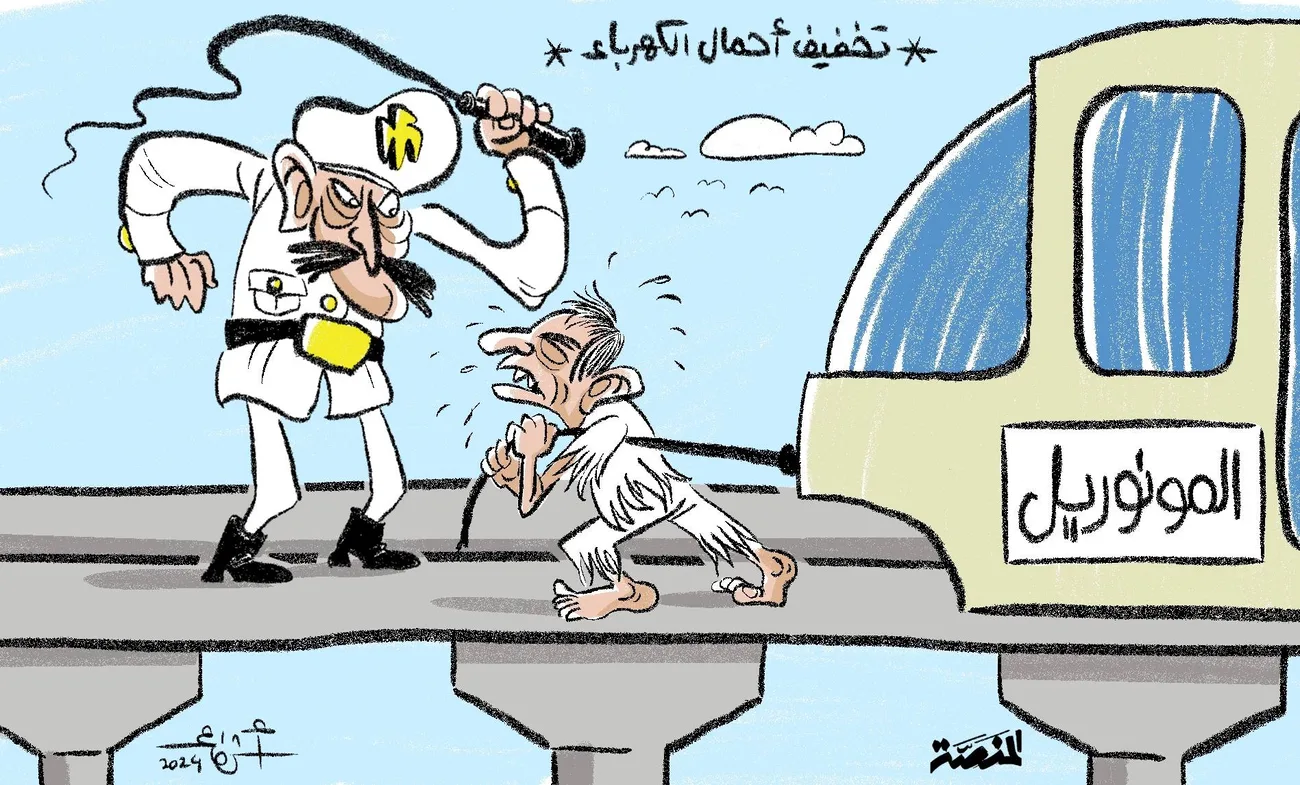
Ashraf Omar, a cartoonist for Al Manassa, was arrested on July 22, 2024. His SSSP interrogators questioned him about his cartoons, including one criticizing the cost of the Cairo monorail, and asked whether his drawings were intended to incite the overthrow of the government. He is now being tried for financing and participating in a terrorist group in Case No. 11846 of 2025. Ashraf Omar’s cartoons were investigated and cited by the prosecuting authority. Debates arose that he was arrested due to a satire cartoon on the monorail in Egypt. The monorail was recently opened for public use after it costed billions of dollars to build. The paradoxical reality between building the monorail with such a high cost and low utility for the average Egyptian while cutting the electricity on most of the Egyptian families as part of lessening the costs of electricity was why this cartoon received attention by the public.
Hassan El Sayed was arrested at Cairo International Airport on December 20, 2025, and is held in SSSP Case No. 4529 for the year 2025, on a charge of joining a terrorist group. El Sayed was placed under enforced disappearance for five days, from December 20 to 25, after his arrest. His family was unaware of his whereabouts or fate during this time. It was later disclosed that on December 22, security personnel brought him to the Supreme State Security Prosecution (SSSP), where a prosecutor questioned him without the presence of an attorney. Hassan El Sayed has appeared before the SSSP seven times since his arrest in brief online hearings. The prosecutor asked him why he had a beard during one of these hearings, which Hassan El Sayed took as a charge of Muslim Brotherhood affiliation. He clarified that he was hiding a scar from surgery on his throat and inquired as to how this might point to a Muslim Brotherhood affiliation. Additionally, Hassan El Sayed was questioned twice by the prosecutor regarding his brief role in the film The Eagles of the Republic. He is still being held in pretrial detention while investigations into baseless accusations of “joining a terrorist group while being aware of its objectives,” which carries a maximum 15-year prison sentence. Amnesty International identifies his brief appearance as a priest in Eagles of the Republic as the basis for his detention. However the formal charge do not mention it
Hani Sobhi, a writer whose most recent short story collection appeared in 2024, was arrested on October 29, 2025, and charged in SSSP Case No. 7143 of 2025 with joining a terrorist group and spreading false news. A terrorism charge moves a case to the Supreme State Security Prosecution and then to the terrorism circuits. These bodies have repeatedly renewed detention over long periods: Ashraf Omar was held for about sixteen months before he was referred to trial. No verified outlet attributes Sobhi’s arrest to a specific artwork, however general debates attribute his arrest to a satirical post.
The second mechanism is the charge of spreading false news. Omar Salah Marei is held in SSSP Case No. 3383 of 2026 over social media posts that criticized political and social conditions and commented satirically on film production. Ahmed Douma was convicted on June 3, 2026 and sentenced to one year with hard labor over an article in Al‑Araby Al‑Jadeed on the effects of imprisonment and a post on detention conditions. The appeal court upheld the sentence in July 2026. The false news offence gives the prosecution the authority to decide which accounts of public life are true. In Douma’s case, the account it rejected was about the prison system itself.
The third mechanism is the use of provisions on religion. On April 14, 2026, National Security in Minya summoned the novelist Peter Tawfik Kamal. He is currently being held under Article 98(f) of the Penal Code in Case No. 1184 of 2026 for allegedly “exploiting religion to promote extremist ideas with intent to show contempt for the revealed religions” online.According to the Egyptian Commission for Rights and Freedoms, the evidence consists of his online posts and his novel “Farwell My Dear God”.
The fourth mechanism is detention itself, which in these cases works as a sanction in itself. El‑Behairy’s three‑year military sentence ended in 2021. He was not released and has been held since then on new cases, bringing his time in prison to more than eight years. In September 2023, he began a hunger strike in Badr 1 Prison in protest at his continued pretrial detention after his sentence had ended. He also attempted to commit suicide on the same month he started his hunger strike. In May 2026, AFTE submitted two petitions to the Public Prosecutor arguing that his detention had exceeded the legal maximum for pretrial detention.² As per Ashraf Omar, he was taken to an undisclosed location for two days before he appeared before the SSSP, and he was held for about sixteen months before he was referred to trial. Omar Salah Marei was arrested in a home raid on May 11, 2026. He was held for several days without contact with his family or lawyers before he appeared before the SSSP on May 16. Since then his detention has been renewed ten times, and his family reports that he has been interrogated only once.
The conditions of detention add to this sanction. Marei has been denied specialist care for a chronic thyroid condition and for his recovery from wrist surgery. The authorities have not provided thyroid tests, imaging of his hand, physical therapy or consultations with specialists, and his family has been refused access to his medical reports. On July 2, 2026, El‑Behairy began another hunger strike after the prison administration confiscated his books, papers and pens and refused to let clothing in for him. His father has reported a recurring medical condition that requires treatment. For a poet detained over his writing, the confiscation of paper and pens extends the original restriction on his expression into his life in prison.
Legally, these violations and repression mechanisms are found to be incompatible with the Egyptian constitution itself, ICCPR (International Covenant on Civil and Personal Rights), and ICESCR (International Covenant on Economic, Social and Cultural Rights). The crimes for which these artists are charged for are usually too broad to untangle and to meet the legality requirements of being definable under Article 19 of the ICCPR. The overall restrictions on artivism also does not meet the necessity defined by law which excuses such penalization. A criminal restriction on expression must be prescribed by law with enough precision to give citizens foreseeability, in advance, of what is prohibited according to the General Comment No. 34, para. 25. There is no foreseeability to determine what speech is criminalized and what speech is allowed in an atmosphere of total restrictions on the freedom of expression. Between poetry, cartooning, acting, filmmaking, writing fiction and acting, the acts of artivism itself is denied to exist. Furthermore, according to paras. 42, 46, and 38 in the General Comment No.34, the use of counter-terrorism laws should be clearly defined and opinion criticizing the government should not be penalized.
Second, according to the Egyptian constitution, Article 67 guarantees artistic and literary creation. It bars custodial penalties for crimes committed because of the public nature of an artistic, literary or intellectual work, and allows cases against creators only through the Public Prosecution. While Article 71 assures that there is no custodial penalty for publication crimes, except for narrow exceptions. The manner by which the Egyptian government is using the crime of “publishing fake news” validates the arbitrariness of this broad offence. And generally, the constitution guarantees the freedom of thought and opinion under Article 65; freedom of thought and opinion which was repeatedly criminalized in each of these seven cases.
Third, according to the ICESCR Article 15(3), freedom is indispensable for creative activity as every artist should benefit from the protection of material and moral interests resulting from any scientific, literary or artistic production.
All of these legal regulations combined assure the illegality of the arbitrary detention of these artists and many more in the Egyptian prisons. Some prisoners had hope for for Egypt’s new Criminal Procedure Law; Law No, 174 of 2025 to come into effect and lessen the period of pretrial detention.On November 12, 2025, it was approved and published in the Official Gazette. Parliament then delayed its application by a year to allow for institutional preparation. Then on the 30th of September 2026, it was delayed for another year to come into force in 2027. The maximum length of pretrial detention is reduced by the law to four months for misdemeanors, twelve months for felonies, and eighteen months for crimes carrying a life sentence or death penalty. Six months, eighteen months, and two years were the prior ceilings. Renewals are allowed for a maximum of fifteen days and are still limited by these total caps. Alternatives to detention are also introduced by the law, such as electronic monitoring, travel restrictions, and prohibitions on contact with specific individuals. For the first time, Article 528 establishes a right to compensation for pretrial detention in certain situations, such as final acquittal and dismissal for lack of evidence. Anyone detained in another case during the same time period is not included. The practice of rotation, which involves adding a detainee to a new, nearly identical case as the first case’s permitted period draws to a close, is not covered by the law. In 2025, Human Rights Watch issued a warning that pretrial detention is perpetually restarted by rotation. As a result, the practice that has kept inmates like Galal El-Behairy incarcerated past any legal limit can both evade the new caps and prevent the inmate from receiving compensation. Letters from inmates in a number of prisons in September 2026 demanded that the caps be applied to those who were already detained. The seven cases show a consistent pattern in how the Egyptian state handles artistic and literary expression. Poets, a cartoonist, an actor, a filmmaker, a novelist and writers are prosecuted under terrorism, false news and religion provisions. In the prosecution, their work appears as evidence, as a subject of interrogation, or not at all. In each case the outcome is prolonged detention. Pretrial detention renewed for months, rotation onto new cases, enforced disappearance before first appearance, and the denial of medical care and writing materials impose a penalty before any court has ruled. Galal El‑Behairy has spent more than eight years in prison over a song and a poetry collection. Ashraf Omar has been detained for more than two years over his cartoons. On September 28, 2026, Omar Salah Marei’s detention was renewed for a further 45 days.
The second postponement of the Criminal Procedure Law, approved by parliament on September 30, 2026, keeps the previous detention ceilings in force until at least October 1, 2027. The government justified the delay by the need to complete electronic notification systems, digitize procedures and train personnel. None of these reasons concerns the pretrial detention ceilings, which require no new infrastructure to apply.