
On Freedom of Expression, Journalism and Punishment in Egypt
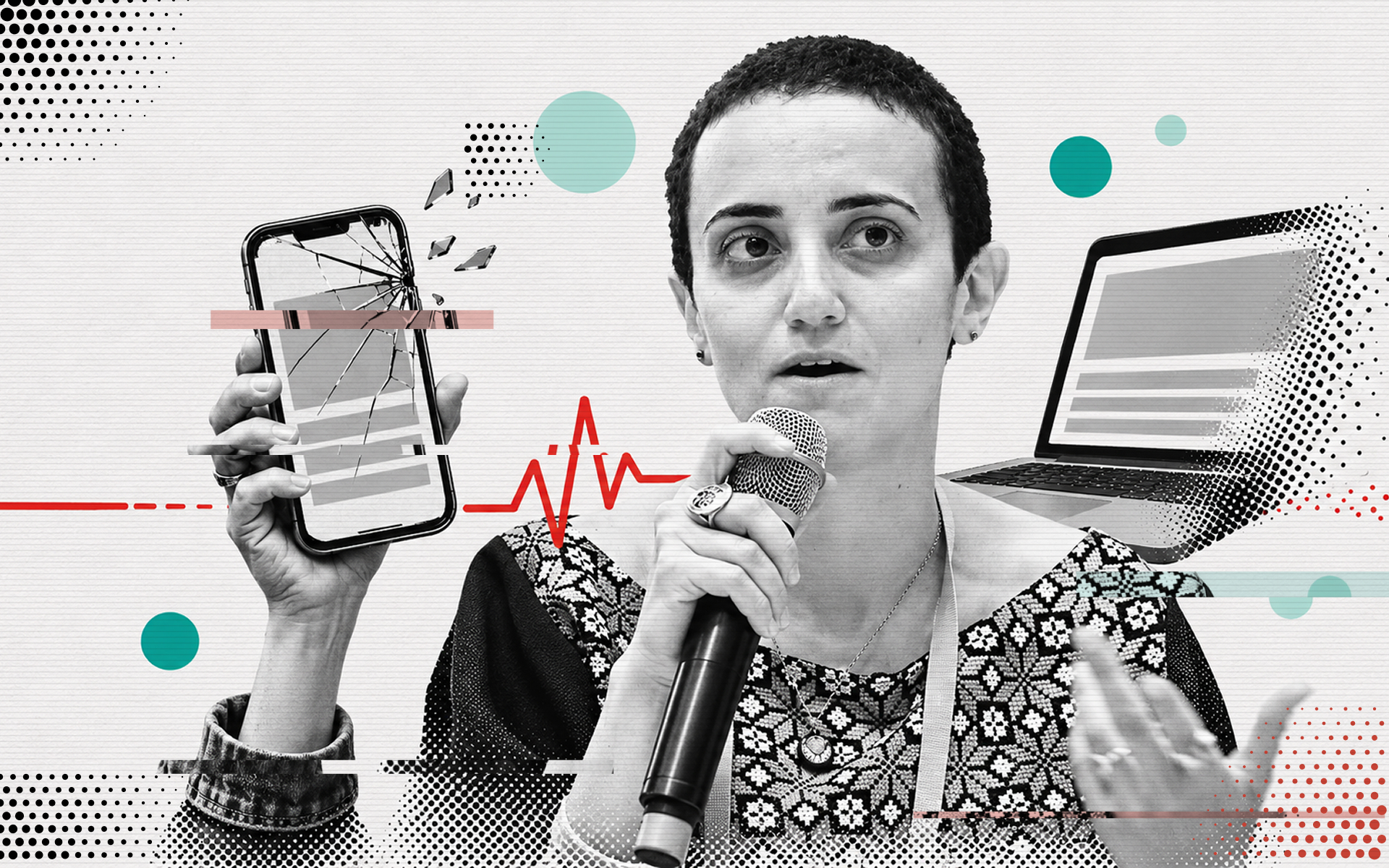
When asked “What does free speech or free expression mean to you personally?” Lina Attalah, editor-in-chief of the independent media platform Mada Masr, replied saying “being able to think without too many calculations and without fear”. In 2026, this answer remains for plenty of journalists definitive to the common and lived understanding of freedom of expression. However, the same answer gets more out of reach. The current Egyptian regime is and has been penalizing journalism and opinion since the very beginning of its rise.
Now, an unprecedented and brutal attack on journalism has been taking place since the end of September, as an entire newsroom was forcibly disappeared, tortured and imprisoned to stop the work of the independent fact-checking platform Matsada2sh. Between 28 and 30 September 2026, security forces arrested its entire Egypt-based editorial team: Mohamed Ashraf Abu Emeira, Abdallah Qadry, Islam Barakat, Omar Helal, Mohamed Mahmoud and Mohamed Adel, four from their homes in Cairo, Gharbiya and Port Said and two from the street. For five days their whereabouts were withheld from families and lawyers, and no arrest warrant was ever shown, despite eighteen submissions by the Egyptian Initiative for Personal Rights (EIPR), which represents them. On 1 October the Ministry of Interior acknowledged the arrests and described Matsada2sh as an unlicensed page run from abroad by a “fugitive” member of the Muslim Brotherhood. The arrest of the entire newsroom shut down Matsada2sh’s work altogether, cutting off Egyptians’ access to fact-checked information and a means of holding officials accountable.
The six surfaced before the Supreme State Security Prosecution (SSSP) on 3 and 4 October in Case No. 8083 of 2026. According to EIPR, most told prosecutors they had been beaten, stripped, given electric shocks and made to read fabricated confessions to camera in National Security Agency facilities; the defence asked that these statements be recorded as complaints and the “confessions” declared void. The charges are not publication offences: joining a terrorist group, financing terrorism, publishing false news and using social media to promote terrorist acts, on the premise of a link to the Brotherhood. Article 71 of the 2014 Constitution prohibits custodial penalties for crimes committed by way of publication, with exceptions limited to incitement to violence, discrimination between citizens and defamation of individuals. That guarantee is not displaced by a prosecutor’s choice of charge. What the charge sheet does is reclassify the conduct: by framing the production of fact-checks as membership in and financing of a terrorist group under Law No. 94 of 2015, the prosecution presents the case as one to which the guarantee never applied, and the constitutional question is circumvented rather than answered. The deprivation of liberty the six are suffering must also be distinguished from any penalty. They are in pretrial detention, a precautionary measure governed by the Criminal Procedure Code, which Article 71 does not regulate; and EIPR has noted that the days of secret detention before they reached the prosecution were justified by the exceptional arrest power of the Anti-Terrorism Law for imminent terrorist threats rather than by the ordinary rules. The effect is that journalists who could not lawfully be sentenced to prison for what they published are imprisoned before any sentence, through a procedure to which the publication guarantee is made irrelevant. The Public Prosecution’s statement of 7 October listed, as the content of the terrorism charge, editorial conduct: highlighting shortcomings in state institutions, downplaying officials’ performance, amplifying grievances. It cited salary transfers from the platform’s foreign-registered owner, paid for years through Egyptian banks, as the prosecution acknowledged. Neither the statement nor roughly thirty hours of questioning of each journalist identified a single report as false. The prosecution declined to hear the journalists as victims in their torture complaints and did not summon the officers named. Five of the six journalists are in Badr 1 prison and the sixth in 10th of Ramadan prison; their detention was renewed on 13 and 27 October. EIPR argues this violates Article 134 of the Criminal Procedure Code of 1950, still in force after parliament postponed the new code to October 2027 on the day before it was due to apply.
Following these arrests, independent platforms in Egypt, Tunisia, Lebanon and Syria stood in solidarity with their tortured and imprisoned colleagues and built a joint newsroom under the slogan “Until they return, fact-checking continues”. Eight outlets announced on 18 October that for six days, one for each detainee, they would fact-check the government’s “Achievements Conference”, Egypt Forum 2026, held from 19 to 24 October.
On the forum’s first day, 19 October, the SSSP summoned Lina Attalah, editor-in-chief of Mada Masr, in Case No. 9072 of 2026, without stating a reason. On 21 October she was questioned for more than six hours on Mada Masr’s funding and board, on a report of 13 October on protests and punitive transfers in prisons, and on its licence.
She was charged with establishing and managing a website without a licence and with publishing false news inside and outside the country, and released on bail of EGP 100,000. The latter accusation is a well-known and elastic charge used to penalize journalists who do not conform to the official narrative of the state. Here, however, it was not taken to court. On 22 October she was referred to trial on the licensing charge alone, Case No. 11743 of 2026 before the Fifth Settlement Misdemeanours Court, with the hearing set five days later.
The charge rests on Law No. 180 of 2018, which requires a licence from the Supreme Council for Media Regulation (SCMR) for Mada Masr to be able to operate and, under Article 105, punishes operation without a licence with a fine of EGP 1 million to 3 million, closure and confiscation. Mada Masr applied in 2018 and 2020 without reply, learned of a rejection only when it was shown to Attalah during a 2022 interrogation, lost a challenge to the Council’s failure to notify it in 2023, and has a further application pending since June 2023. Two legal problems sit inside this provision before any question of how it was applied. The first is constitutional. Article 71 prohibits the censorship, confiscation, suspension or closure of Egyptian newspapers and media outlets in any form, except for limited censorship in wartime or general mobilization. Law No. 180 restates that prohibition in its own Article 3, then provides in Article 105 for closure and confiscation as penalties for operating without a licence. The court imposed both. The conflict is between the texts themselves, and Mada Masr’s case is the first in which a court has given it effect against a news organization.
The second is one of international law. Under Article 19(3) of the ICCPR, any restriction on expression must be provided by law, serve a legitimate aim, and be necessary and proportionate; General Comment No. 34 adds that restrictions on websites must be content-specific and that generic bans on a site’s operation are incompatible with the Covenant. The licensing requirement as administered, a fine at the statutory maximum imposed without reasons, and the closure and confiscation of the outlet each fail this test.
The hearing of 27 October before the Ninth Circuit of the New Cairo Misdemeanours Court, under Judge Mohamed Mubarak, lasted one session. As described by Hossam Bahgat of EIPR, who attended, the eight defence lawyers received the file in the courtroom and asked for time to review it, for the licensing documents to be admitted and for witnesses. The court cleared the room of everyone but Attalah and her lawyers, rejected every request and ordered the defence to plead. When they declined, the judge appointed a lawyer unknown to them over Attalah’s objection, which he refused to minute, and read the verdict over the defence’s protests: the maximum penalty, EGP 3 million, closure of the website and confiscation of its equipment. Security personnel carried her out of the room; she was released after about seven hours once the fine was paid.
Measured against Articles 96 and 98 of the Constitution and Article 14 of the ICCPR, the hearing fails on three counts: no adequate time or facilities to prepare a defence (14(3)(b)); denial of counsel of one’s own choosing (14(3)(d)); and exclusion of the public before the verdict without any of the grounds 14(1) permits.
During her release Attalah was informed of a one-year prison sentence issued against her in absentia in 2024, for false news and an unlicensed website, in a case of which she had never been notified, so that she had no opportunity to defend herself in it; a retrial is set for 11 November.
2017: Blocking as the first instrument
Mada Masr has been inaccessible inside Egypt since 24 May 2017, when the authorities ordered providers to block 21 news websites. No decision was published, no outlet was notified, and no legal basis was stated. The absence of a public decision meant there was nothing to appeal. Security sources told Reuters the sites were Brotherhood-affiliated or Qatari-funded; Mada Masr, an Egyptian-registered company, was listed alongside Al Jazeera, HuffPost Arabi and Masr al-Arabia. The Association for Freedom of Thought and Expression counted 496 blocked sites by 1 February 2018, mostly news platforms. An explicit statutory power to block websites came only in 2018, with Law No. 175 on information technology crimes and Law No. 180 on the press and media, whose Articles 6 and 19 authorize the Supreme Council for Media Regulation to block unlicensed sites and sites publishing “false news”. Law No. 180 also created the licensing regime under which Attalah was convicted eight years later. The block was never lifted; in March 2024 the Journalists’ Syndicate noted that several sites had been unblocked while Mada Masr and Al Manassa remained inaccessible.
2018: Case 441 and mass imprisonment
If 2017 showed that an outlet could be made invisible without a public decision, 2018 showed that journalists could be imprisoned en masse under one case number. Case No. 441 of 2018, called in the press the “media cells of the Muslim Brotherhood” case, absorbed journalists, bloggers, lawyers and students arrested around the March 2018 presidential election, all charged with joining an illegal group and publishing false news. Moataz Wadnan of HuffPost Arabi was arrested in February days after an interview with Hesham Geneina, disappeared for five days while the prosecution denied holding him, and was then held past the two-year legal ceiling on pretrial detention. Adel Sabry, editor of Masr al-Arabia, was granted bail in July in the case opened over the raid on his outlet and was brought before the SSSP the next day, added to Case 441 and returned to prison. Others, among them Mostafa al-Aasar and Hassan al-Banna, taken from the street, and the blogger Wael Abbas, taken from his home, followed the same route.
Three elements of Case 441 recur in everything that follows: enforced disappearance between arrest and prosecution, during which the state denies holding the person; the pairing of a terrorism charge with a false-news charge, which reclassifies publication as a security offence and so routes it around the guarantee of Article 71; and pretrial detention renewed in fifteen- and then forty-five-day increments, so that a measure the law defines as precautionary performs the function of a sentence that could not lawfully have been imposed for the publication itself. Sabry’s transfer from one case to the next on the day of his release added a fourth, the recycling of detainees between cases, which would become routine. The same summer produced Laws No. 175 and 180, the legislative architecture now applied to Mada Masr.
After 2018, journalism was pushed by the authorities to be more conservative, less confrontational with the state. Few independent media platforms remained to cover the political and social landscape of Egypt. Different journalists reported that the previous decade under the current government was “a masterclass in self-censorship”. The recurrent repression faced by journalists resulted in a chilling effect on freedom of expression overall. However, this state of self-censorship was not enough for the state itself, which continued its attacks on the independent media platforms and attempted to close two of the few remaining ones, Mada Masr and Matsada2sh.
2019 to 2020: The raid and the first arrests
On 23 November 2019 security forces took Shady Zalat, a Mada Masr editor, from his home to an undisclosed location. The next day plainclothes officers raided the office, seized devices, held everyone present for hours, and took Attalah, Mohamed Hamama and Rana Mamdouh to a police station before releasing them. The raid followed an investigation concerning the President’s son, and the Foreign Ministry justified it on the ground that the outlet operated without legal authorization: the missing licence was already a reason for a raid seven years before it became the basis of a conviction. On 17 May 2020 Attalah was arrested outside Tora prison while interviewing Laila Soueif, mother of Alaa Abd El Fattah, then on hunger strike. Attalah was penalized at every stage of journalistic work with the same pressure. At Maadi police station she was accused in Case No. 8009 of 2020 of photographing a military facility without a permit and released on bail of EGP 2,000. This is the first instance of a pattern repeated with rising amounts: arrest or summons, hours of questioning, a charge left open, release on bail. The case was never closed.
2022 to 2025: Summons and bail as punishment
From 2022 the state’s dealings with Mada Masr ran recurrently through the prosecution. On 31 August 2022 the outlet reported that a state oversight body had implicated senior Nation’s Future Party members in gross financial misconduct. Party members and MPs filed hundreds of identical complaints nationwide, consolidated in Case No. 19 of 2022; on 7 September the Cairo Appeals Prosecution questioned Attalah and the three bylined journalists, Rana Mamdouh, Sara Seif Eddin and Beesan Kassab, for defamation, harassment through social media and false news. Attalah was additionally charged with running an unlicensed website, and it was in this session that she was first shown the SCMR rejection. Bail was EGP 20,000 for her and 5,000 for each of the others. In 2023 the three journalists were tried on one complaint before an economic circuit in Mansoura for offending MPs and misusing communications channels. The fourth case came from the regulator: after an SCMR complaint over a report on the possible displacement of Palestinians from Gaza into Egypt, the Cairo Appeals Prosecution questioned Attalah on 20 February 2024 for false news and an unlicensed website and released her on EGP 5,000 bail. The fifth followed the report “Badr 3: Where Prisoners Face ‘Slow Death’” of 31 July 2025: on 4 August the SSSP questioned Attalah on a National Security report, charged her with false news and an unlicensed website in Case No. 6182 of 2025, and released her on EGP 30,000 bail. Her record runs EGP 2,000, 20,000, 5,000, 30,000 and 100,000 before the fine of 3 million. None of the investigations has been closed; each open file is a reserve that can be reactivated by referral, as the 2024 case apparently was, without the defendant being told.
The same mechanism has been applied with greater intensity to the activist and writer Ahmed Douma. Pardoned in August 2023 after a decade in prison, he was summoned by the SSSP six times in the following seventeen months over social media posts and articles, each time on false-news charges, and released each time on bail; by January 2026 the bail he had paid came to roughly EGP 230,000, more than two and a half years of the minimum wage, a practice that eight organizations described as indirect punishment and financial attrition. The seventh summons ended the cycle: on 6 April 2026 he was detained over an article and a post on detention conditions, and on 3 June the New Cairo Misdemeanours Court sentenced him to one year with labour under Articles 80(d) and 102 bis of the Penal Code, a custodial sentence for a publication offence that Article 71 prohibits; the appeal was rejected on 16 July.[1] Rasha Azab, too, was summoned on 4 October 2026 after joining the Syndicate sit-in for Matsada2sh, and charged in Case No. 8025 of 2026 with promoting terrorist acts over a tweet about the Ministry of Interior and released on EGP 10,000 bail.
September 2026: Matsada2sh, from fact-checking to terrorism
Matsada2sh’s site is blocked and its Facebook page has over a million followers. It had been targeted once before, when Karim Asaad was arrested in August 2023 after its coverage of a private jet seized in Zambia. On 19 October, as Attalah was summoned, the government launched Chat EGYPT, an AI platform for checking news: the state’s claim to a monopoly on verification given institutional form while those who practised it independently entered their third week in detention.
October 2026: Mada Masr again
The case against Attalah differs from the Matsada2sh case in legal form and matches it in function. The six are held under the Anti-Terrorism Law; Attalah was tried under a media statute for a misdemeanour punishable only by a fine. The outcome in both is the end of the outlet. The choice of the licensing charge over false news is telling: a false-news trial would have required the court to engage with a prison report sourced through lawyers; a licensing trial requires only the regulator’s rejection letter, which, in the words of Fakar Tany’s publisher, sits in a drawer until needed. No independent outlet holds a licence under Law No. 180; the charge is available against every one of them at any time. The timing completes the convergence: summons on the forum’s first day and hours after Mada Masr joined the newsroom replacing Matsada2sh’s work, referral three days after questioning, conviction five days after referral, on the same day the six had their detention renewed a second time. Appeals have been announced. What the ruling means for a site blocked since 2017 is unclear; in law it means that the editor of Egypt’s last major independent outlet now carries a criminal conviction, an in absentia conviction awaiting retrial, five open State Security investigations and an order confiscating the means by which she works.
The record from 2017 to 2026 is a sequence of instruments. Blocking made outlets invisible without a public decision. Case 441 made journalists prisoners without a trial, by reclassifying publication as terrorism and substituting pretrial detention, which Article 71 does not regulate, for the custodial sentence it forbids. Summons and bail made the investigation itself the penalty, paid in instalments of money and time and kept open as a reserve. Matsada2sh returned to the method of 2018 and applied it to a whole newsroom. Attalah’s conviction added a criminal court applying a licensing statute in one session, and the 2024 judgment showed that convictions, like cases, can be held in reserve. Across these instruments the legal category shifts, from terrorism to false news to licensing, while the object is constant: describing the state in terms other than its own. Lina Attalah’s definition of free expression, thinking without too many calculations and without fear, names precisely the condition each instrument is designed to make impossible. Punishment here does not follow a finding that something false was published. It follows the decision to publish at all, and the bail, the renewed detention, the fine and the in absentia sentence are the forms it takes while the question of truth is never reached.
These patterns of repression target journalists themselves and the wider public’s access to independent information. Journalists are targeted as an example of what happens to a person who speaks the truth and exercises the right to freedom of expression; the warning is addressed to everyone else. The pressure produces self-censorship. The current regime is building a system of silencing in which journalists are the first victims and the wider public, left without access to the information that shapes its life, is the intended one.
[1] Read more: https://humena.org/ahmed-douma-freedom-after-presidential-pardon-egypt/
Media enquiries: [email protected]
Read next

New publications, by email
Concise briefings on new HuMENA research, statements, and advocacy.
Subscribe