
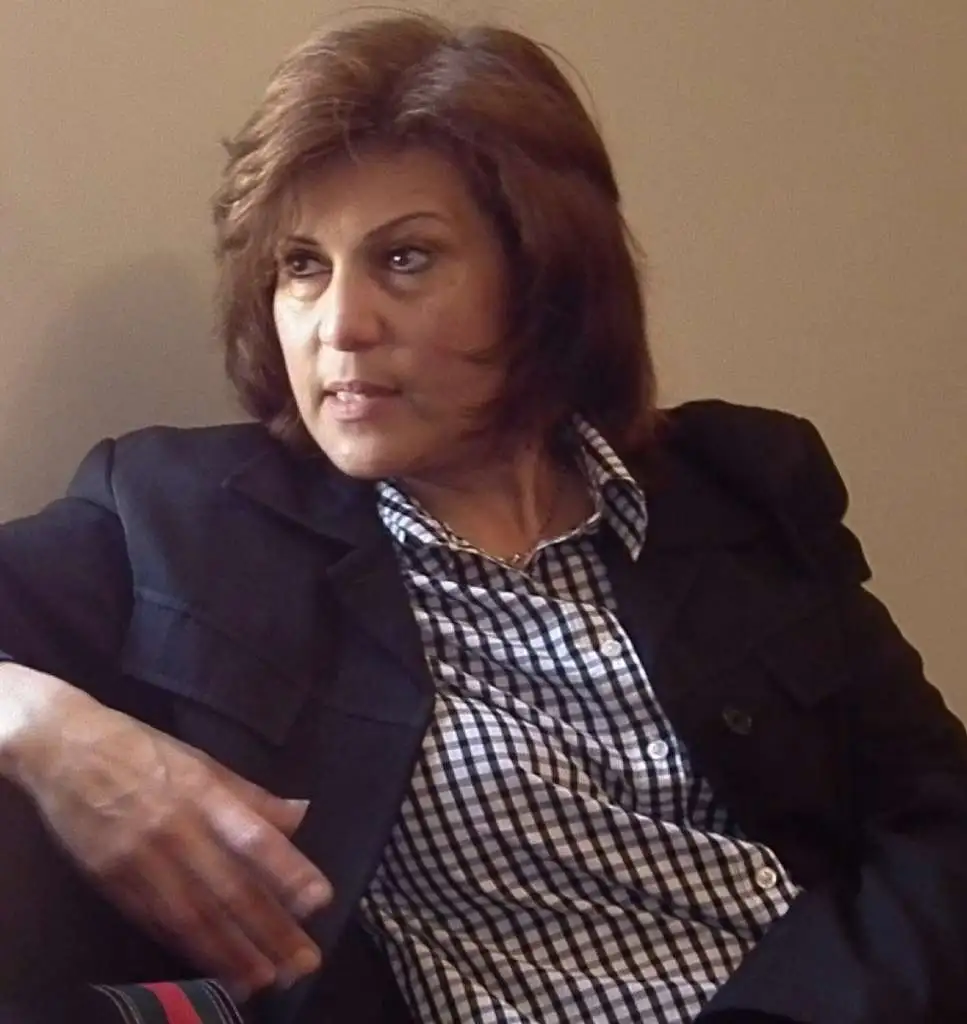
Salwa
Bugaighis
Salwa Bugaighis, a Benghazi human rights lawyer and advocate of women's political participation, was shot dead at her home on 25 June 2014, the day of Libya's parliamentary elections, and her husband Essam al-Ghariani was abducted the same day. No effective investigation has taken place, her killers remain unidentified and her husband's fate is unknown.
- Country
- Libya
- Role
- Lawyer
- Status
- Killed
- Name in Arabic
- سلوى بوقعيقيص
The arrest, and what followed.
Update, 12 November 2026: twelve years after Salwa Bugaighis was shot dead at her home in Benghazi, her killers have not been identified and the fate of her husband, Essam al-Ghariani, abducted in the same attack, remains unknown. No investigation or prosecution has been made public.
Background and Work
Salwa Bugaighis was a Libyan lawyer and human rights activist from Benghazi. She played a prominent role in organising protests at the start of the 2011 uprising and was a member of the National Transitional Council, the first opposition government. She advocated gender equality and women's participation in political life, campaigned for a quota for women in parliament and for women's right to choose whether to wear the headscarf, and opposed making Islamic law the sole source of legislation in the constitution. In the months before her death she worked on the Preparatory Committee for National Dialogue. Her sister, Iman Bugaighis, has continued to speak publicly about the case.
Friends told Amnesty International that she had received several threats in connection with her public appearances and political positions. Al Jazeera reported that she returned to Libya shortly before the 2014 elections despite death threats.
The Killing
On 25 June 2014, the day Libyans voted for a new House of Representatives, she cast her vote and, hours earlier, gave a telephone interview to al-Nabaa TV about heavy fighting in a residential area of Benghazi, calling for polling stations to be protected. That day armed men, described as hooded and wearing military uniforms, attacked her home. Amnesty International reported that she was shot several times in the chest, stomach and head; she died shortly after being taken to hospital. Al Jazeera reported that a security guard was wounded. Lawyers for Justice in Libya later said five gunmen broke into the house.
Her husband, Essam al-Ghariani, an elected member of the Benghazi municipal council, was abducted the same day. His fate and whereabouts remain unknown, and Lawyers for Justice in Libya has described his case as an apparent enforced disappearance by her attackers.
Legal Proceedings
The authorities said they would investigate, but Amnesty International reported in June 2018 that no effective investigation had ever been launched. Human Rights Watch noted in November 2020 that no one had been investigated or prosecuted for the killing. On the seventh anniversary, in June 2021, Lawyers for Justice in Libya said there had been no meaningful investigation, and the International Commission of Jurists said in December 2023 that no one had been held accountable. No suspect has been publicly named.
International Response
The United Nations led international condemnation in June 2014. Amnesty International called for a full, independent and impartial investigation and for protection for activists, and Human Rights Watch said her voice had been vital for Libya. The ambassadors of the United States and the United Kingdom also condemned the killing, and vigils were held across Libya.
Rights groups have placed her killing at the start of a pattern of attacks on women in Libyan public life. Amnesty International noted that Fariha al-Berkawi, a former member of the General National Congress, was killed in Derna on 17 July 2014, and that Entisar al-Hassari was killed in February 2015, and that in each case no proper investigation was conducted. Human Rights Watch cited her case in November 2020 when the Benghazi lawyer Hanan al-Barassi was shot dead, alongside the abduction of the parliamentarian Siham Sergiwa from her Benghazi home in July 2019. In its 2024 submission to the UN Committee on the Elimination of Discrimination against Women, Amnesty International said the failure to prosecute the 2014 assassinations had led many Libyan women activists to stop their work or leave the country.