Under authoritarian regimes where democracy disappears, citizens become systematically excluded from the public space. Democracy determines the level of participation of individuals in deciding their own fate, in choosing, in speaking and organizing. Authoritarian regimes operate contrarily to this, they operate to conceal the citizens from speaking, organizing and taking an active part in the civic space. Authoritarian regimes operate through shutting the spatial spheres where citizens can exist as political agents. Therefore, they conceal the public from the political, and in most extreme cases of this systematic concealment and exclusion, enforced disappearance of a person occurs.
Enforced disappearance:
Enforced disappearance is defined as “the arrest, detention, abduction or any other form of deprivation of liberty by agents of the State or by persons or groups of persons acting with the authorization, support or acquiescence of the State, followed by a refusal to acknowledge the deprivation of liberty or by concealment of the fate or whereabouts of the disappeared person, which place such a person outside the protection of the law” ”. In this context, enforced disappearance is directly linked with anonymity of fate. More accurately, it is a disappearance from existence.
Authoritarian regimes —as evident in the Arab world– depend on the methodology of enforced disappearance to widen its scope. Societies become enforceably concealed. They disappear from the public sphere. They become slowly and steadily invisible as political agents able to gear and influence the politics governing their daily lives.
Enforced concealment is a direct effect of the carceral states of the Arab World. In his description of the carceral archipelago, Michel Foucault explains how disciplinary power, once restricted to the prison, spreads throughout society until the prison is no longer an anomaly but rather the norm. The prison extends beyond its walls into other institutions of contemporary life, such as the factory, the school, the army, and ultimately the street itself. Practicing the right to organize, speak and express in the civic space as a whole becomes punishable acts. By widening the scope of acts that can be considered “punishable”, political participation in itself becomes a crime. An example of this diffusion in the Arab world is demonstrated by authoritarian governments. The ensuing order has been referred to by academics studying Egypt under Sisi as a “carceralocracy,” a form of government in which mass political imprisonment serves as the main tool of governance rather than as a punitive adjunct. More than sixty new prisons have been constructed by Egyptian authorities since 2011, and between 65,000 and 100,000 people have been detained on political charges. This number cannot be justified as an extraordinary security measure; rather, it must be interpreted as a form of governance.
Tunisia is another example of how detention can go beyond an exceptional security measure and become a regular way of dealing with political and civic dissent. Since 2023, authorities have increasingly used arrests, pre-trial detention and criminal prosecutions against opposition figures, lawyers, journalists, activists and human rights defenders. This suggests that detention is used not only to punish political activity, but also to discourage criticism and limit civic participation.
Algeria also shows how detention and criminal law can be used to restrict civic and political participation. Authorities have continued to use pre-trial detention in cases involving activists, journalists and other critical voices, while broad criminal provisions are used against peaceful expression, including social media posts and political activism. This can make detention not only a response to dissent, but also a way to discourage people from speaking out or taking part in public life.
In this way, the carceral state does more than just penalize political action after the fact. It anticipates and absorbs it, turning people into subjects whose only connection to the state is that they can be detained.
As a result, people either accept, produce and reproduce the authority practiced upon them. They internalize the omnipresent surveillance to monitor their own political identities and render them to conform with the existing “concealed” identity. Otherwise, they risk actual enforced disappearance and imprisonment. Under the limited options of “being” in the Arab world, the being of the self itself as a political agent in the public sphere becomes contested, challenged and disfigured.
Concealment and Democracy
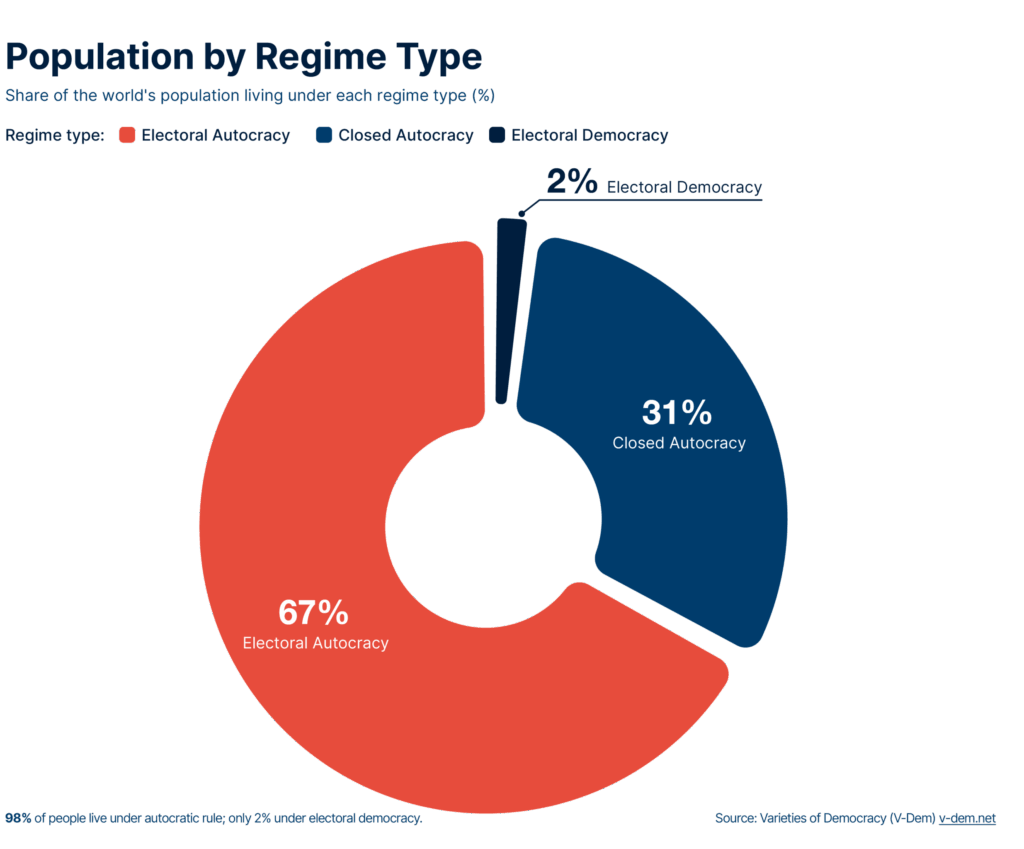
This concealment of the individual from the public sphere is linked to the undemocratic and authoritarian regimes. This is reflected in the Arab world through indicators. The degree to which a state combines electoral competition with effective checks on executive power, judicial independence, and the equal protection of civil liberties is measured by the V-Dem Institute’s Liberal Democracy Index. Robert Dahl’s idea of polyarchy is defined as a form of government where power is invested in multiple people and control over leaders is shared among a large group or plurality of citizens. Polyrchy is operationalized by its companion measure, the Electoral Democracy Index, which looks at election quality, freedom of expression, freedom of association, and the availability of alternative information sources. The Arab world does not merely perform poorly by these standards. According to both indices, it is the least democratic region in the world since the turn of the century. As of 2025, only 2% of the people in the area reside in electoral democracies, which are only found in one state. Nearly one-third of the population in the region is ruled by governments that completely do away with the pretense of electoral competition, with 67% living under electoral autocracy and 31% under closed autocracy. In 2025, no state in the region achieved democracy; instead, Kuwait and Libya advanced toward autocracy, with the former doing so by dissolving the National Assembly and suspending constitutional provisions pertaining to legislative authority.
On the other hand, based on the degree to which states allow the freedoms of association, peaceful assembly, and expression, CIVICUS Monitor provides a more focused but more detailed index that rates civic space in five categories: open, narrowed, obstructed, repressed, and closed. None of the nineteen Arab nations that CIVICUS evaluates are rated as narrow or open. Only two fall into the intermediate category of obstructed, with ten being classified as closed and seven as repressed. Since the index measures exactly the channels through which political agency would otherwise be exercised, this distribution shows that the concealment mentioned above is reproduced as a regional condition rather than being incidental to specific regimes. The five most commonly reported violations—detention of human rights defenders, penalization and detention of journalists, judicial harassment, criminal cases aimed at suppressing the role of the opposition, censorship, and deportation of human rights defenders—collectively describe a set of methods for removing people from the public sphere rather than just limiting their activity within it.
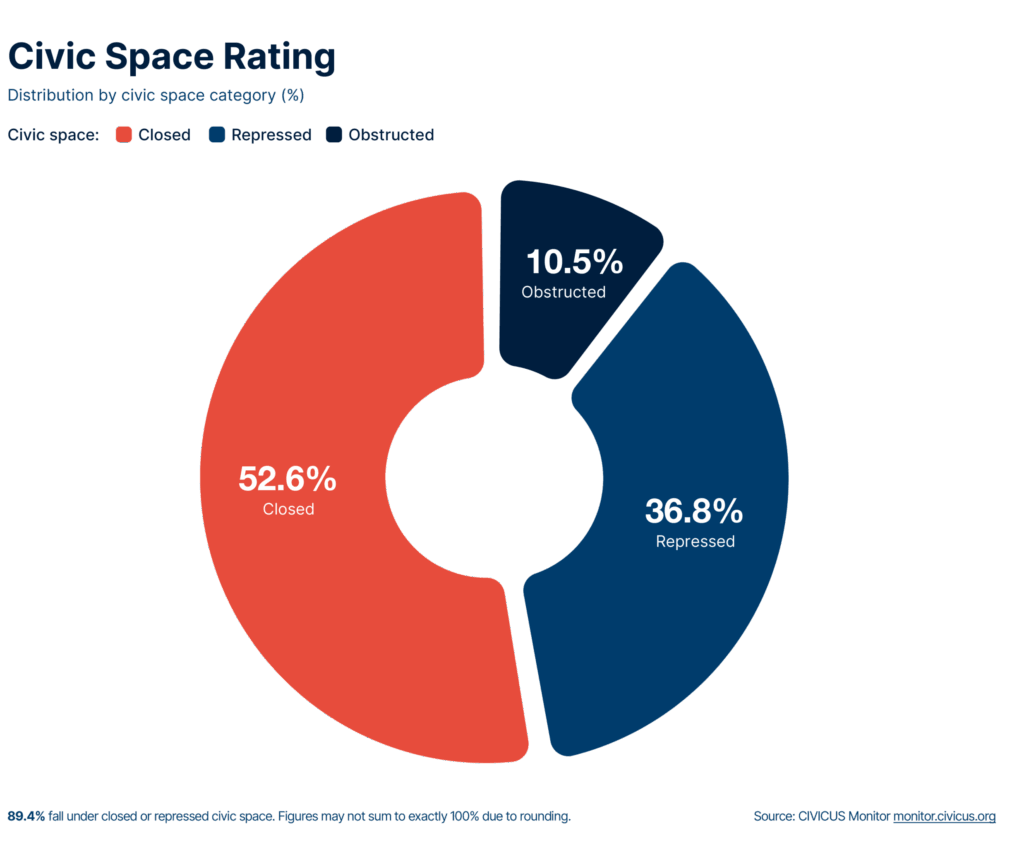
For the argument, it is instructive where the two indices converge. CIVICUS measures the lived space that civil society has within the regime, whereas V-Dem measures the regime’s formal structure. Their agreement that the Arab world scores at the bottom of both shows that the closure is never limited to constitutional or social causes, as it operates at both levels concurrently. This is what enables the concealment of the individual to generalize into the concealment of society as a whole.
Understanding Authoritarianism and Concealment Legally
The discrepancy between formal democratic commitment and its practice has been codified. The International Covenant on Civil and Political Rights, which guaranties freedom of expression under Article 19, freedom of peaceful assembly under Article 21, freedom of association under Article 22, and the right to participate in public affairs and vote in legitimate periodic elections under Article 25, sets the legal standard by which the region’s practices must be evaluated. These are the particular rights whose exercise is measured by CIVICUS’s five-category rating system, meaning that the legal obligation and the indicator describe the same thing from two distinct perspectives in a normative and empirical manner. Practicing these rights is fundamental to enhance the operational conditions of democracy, since expression, assembly, association, and political participation are the mechanisms through which citizens form, coordinate, and act on collective political will. Restricting them therefore violates both the individual right at stake and the collective process that right sustains, and it does so by removing precisely the voices most likely to hold power accountable from civic and political life.
The Arab Charter on Human Rights, which was adopted in 2004 and has been in effect since 2008, is another regional document that the region has. The then-UN High Commissioner for Human Rights criticized the Charter for setting the region’s human rights standards below the internationally recognized regime and for being incompatible with the UN’s own understanding of universal human rights. For instance, Article 3.3 in the Charter qualifies gender equality by subjecting it to “the positive discrimination established in favor of women by the Islamic Shari’a,” a conditional formulation that conflicts with CEDAW’s standard by making equality dependent on a particular doctrinal framework rather than treating it as an unconditional guaranty. Also, article 7 which prohibits the death penalty for children, however it creates an opening for domestic law to decide. The Charter reproduces guarantees of assembly and association in language similar to the ICCPR. The pattern this article describes is demonstrated by the existence of a regional charter that both restates and dilutes international obligations, allowing states to operate under a standard designed to require less of them while still claiming formal legal compliance.
The International Convention for the Protection of All Persons from Enforced Disappearance, which has been in effect since 2010, is a specific document that addresses enforced disappearance. Only six of the Arab League’s twenty-two members—Iraq, Mauritania, Morocco, Oman, Sudan, and Tunisia—are parties. Algeria has signed the convention in 2007 but to the moment has not ratified it. The nations with the most well-documented disappearance practices—Syria, Egypt, Saudi Arabia, the United Arab Emirates, and Yemen, among others—are the ones that have refused to sign the one convention created expressly to outlaw and address the practice. Here, the lack of ratification serves as a legal formulation unto itself, a purposeful departure from the particular accountability mechanism that would otherwise be in place. When compared to the ratification pattern, the states with the lowest scores for civic space and democracy are also those that have rejected the one convention that requires them to criminalize domestic disappearance, create guaranties of habeas corpus against it, and collaborate with international search and accountability mechanisms. A state’s obligations would not only be strengthened by ratification of the ICPPED. The CIVICUS and V-Dem scores indicate that these states have no intention of submitting to the particular enforcement architecture, criminalization of the act, right of victims’ families to information, and obligation to conduct an investigation.
When considered collectively, these three layers; the international covenant that the majority of states have ratified, the regional charter that restates its guarantees in a weakened form, and the convention specific to disappearances that the majority of states have refused to join. Additionally, it results from the selective architecture of the laws that states decide to abide by.
The state of exception is made permanent by legislation rather than an exceptional decree, which serves as a recurring device to maintain this legal architecture. Here, Giorgio Agamben’s account of the state of exception is helpful: contemporary sovereign power operates less through the direct application of law than through its capacity to suspend law while remaining formally inside it, producing a zone of indistinction in which the exception ceases to be an occasional departure from the legal order and becomes its hidden foundation. After being officially lifted in April 2011, Syria’s 1963 emergency law, which had been in effect for 48 years, was replaced in a matter of months by a counterterrorism law that replicated its fundamental powers, including increased detention authority and a specialized counterterrorism court that operated independently of the regular legal system. Legal experts have referred to this substitution as a “trojan horse,” whereby the state can formally and internationally declare that the emergency has ended while the vocabulary of counterterrorism absorbs the substantive powers of emergency rule. Since the official end of the declared emergency did not restore the regular legal order but instead consolidated its suspension into a permanent statute, this is exactly the operation that Agamben refers to as the exception becoming the rule. Egypt had a similar trend. Its emergency law, which had been in effect for the majority of the time since 1967, was permitted to formally expire in 2021. However, its practical purposes had already been transferred into a 2015 counterterrorism law and an expanding system of terrorist entity designations, which allow the same indefinite detention and movement restrictions that were previously justified under emergency powers but are now incorporated into the regular legal order rather than designated as an exception.
Tunisia provides a recent example of how exceptional measures can become part of the regular legal and political system. Tunisia has remained under a state of emergency since November 2015, with the measure repeatedly renewed. It is currently in force until 31 December 2026. On 25 July 2021, President Kais Saied invoked exceptional powers to dismiss the prime minister, suspend parliament, lift parliamentary immunity and take control of the public prosecution. He later dissolved parliament and, in September 2021, suspended most of the 2014 Constitution and gave himself the power to rule by decree. In 2022, he dissolved the High Judicial Council and replaced it with a new body. The 2022 Constitution then further concentrated power in the presidency. Measures initially presented as exceptional were therefore followed by lasting changes to the legal and institutional system, weakening checks on executive power.
Only in the event of a declared public emergency, to the extent that it is strictly necessary, and subject to notification and eventual reporting, is the ICCPR permitting derogation from certain rights. By moving the essence of the violation into ordinary law, a permanent counterterrorism regime cements this framework. In Agamben’s words, what would otherwise need to be acknowledged as a suspension of rights becomes the regular operation of the legal order itself. The same mechanism, the redescription of suspended rights as their standing administration, is used at the legal level to accomplish the concealment this article has traced at the individual and societal levels.
This is made worse by the role of the judiciary. The one institutional mechanism—judicial independence—that both the ICCPR and the Arab Charter supposedly guarantee as a check on executive power is eliminated in the majority of the region because the courts with the authority to try cases pertaining to politics and terrorism are located outside the regular judicial hierarchy and are staffed or reviewed by executive appointees. Institutions that keep the name of the guarantee while losing its purpose hollow out the legal formulations intended to guarantee democratic participation from within.
Personalizing Authoritarianism and Concealment
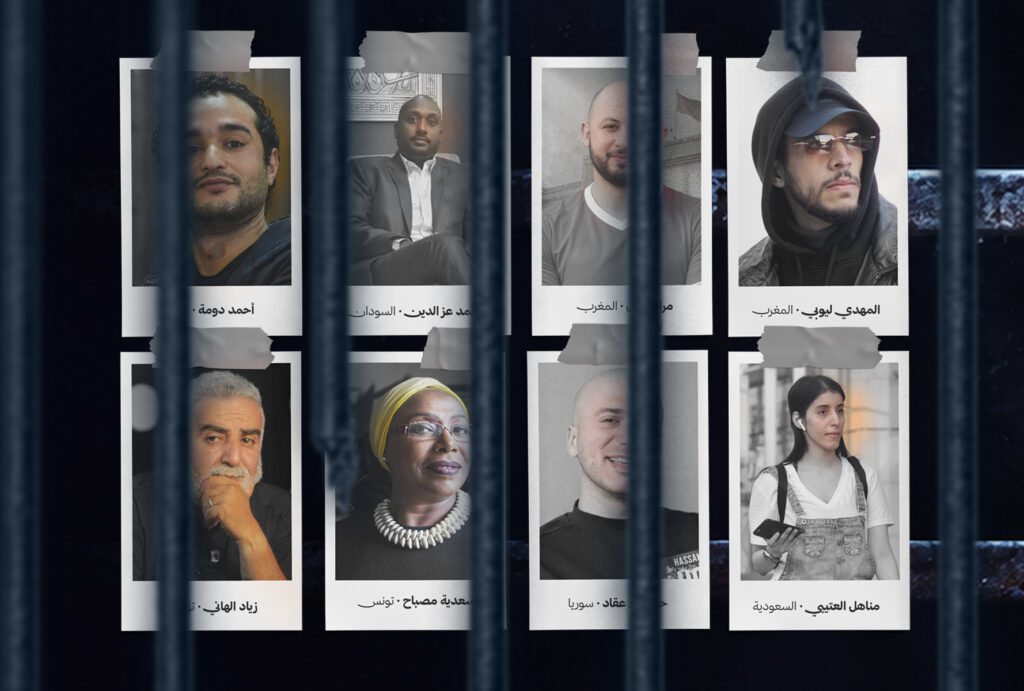
The indexes and indicators of CIVICUS and V-Dem, the carceral Foucauldian theories, and Agamben’s state of exception describe a reality in the Arab world. This reality is practiced through active attempts to conceal the activists who refuse to cease to exist. In this context, concealment in authoritarian regimes can be understood and can be traced through the daily lives who are fighting for their existence. The following people illustrate the different mechanisms through which voices are excluded from civic space.
Ahmed Douma is among these people in Egypt. Douma, a poet and writer who was pardoned by the president after serving almost ten years in prison for his activism, might have been expected to withdraw from public life following his release. Rather, his ongoing description of what he saw inside Badr 1 prison; including the use of bright lighting as a sleep deprivation technique he described as torture, became the foundation for the prosecution. He complied with the State Security Prosecution’s summons in April 2026 and was taken into custody. By June, a court had denied the defense’s requests to call witnesses or view the prison conditions he had described and sentenced him to a year in prison and a fine. The case exemplifies the exact mechanism described earlier in this article: the transfer of emergency powers into the regular state security prosecution apparatus, which is now used against testimony regarding an act rather than an act itself.
From Egypt going South, the case of Mohammed Izzeldin in Sudan demonstrates how victims of the state can extend to anyone who is actively attempting to change the status quo even in the times of humanitarian crises. Izzeldin is a lawyer who represented victims of violence against women and children during the war. He was abducted by armed men dressed in civilian clothes without a warrant. Then, he was detained without charge for more than a year before being charged under the 1991 Criminal Code for crimes that carry the death penalty. The torture that was documented during his interrogation, including electric shocks and sleep deprivation, took place entirely during the time that his existence was legally unacknowledged.
In North Africa, Tunisia and Morocco provide examples of speech offenses. Mourad Habal was sentenced to four months in prison for Facebook posts, while El Mahdi Lyoubi was prohibited from traveling and placed in pretrial detention due to song lyrics while his prosecution continues with an expected court hearing on 2 October. Article 86 of the Telecommunications Code which dates back to the Ben Ali era, survived the transition in Tunisia and has continued to be used against journalists and critical voices. It was used against Haythem El Mekki for reporting on hospital overcrowding, and against Seifeddine Arfaoui for participating in a protest and raising a critical slogan. Journalist Zied El Heni was also prosecuted under the same article. In 2026, he was sentenced to one year in prison after being prosecuted over comments and social media posts criticizing the handling of a judicial case. Saadia Mosbah’s eight-year sentence, upheld in June in a case involving financial charges linked to her anti-racism work, reflects a broader pattern also seen in the Sudanese and Egyptian cases discussed above: activism and civil society work can be turned into conduct subject to criminal prosecution and imprisonment.
Concealment and enforced disappearance are concurrently taking place in Algeria. Algerian authorities shut down SOS Disappeared’s Algiers office in March 2026. Through this organization, families of the missing had banded together to demand answers. In this context that does not challenge enforced disappearance and concealment in the same time, organizations cease to exist when they attempt to unravel the whereabouts of the existence of others.
Migrating to the levant, the legal tools designed to uphold the previous order in Syria have not been destroyed. Hassan Akkad was detained under Law No. 20 of 2022, the cybercrime law enacted under Assad, which criminalizes vague offenses like undermining the state’s prestige, as a result of his campaign to track reconstruction pledges and expose corruption among individuals connected to the former regime. In this case, concealment travels from one regime to another to create systematic alienation to the people wanting to truly achieve accountability.
In the gulf, Manahel al-Otaibi was prosecuted in Saudi Arabia for his opposition to the male guardianship system. He was given an eleven-year sentence, which was later lowered to five. The trial took place in secret. The existence of enforced disappearance within a sentence that was, on paper, lawful is what her case adds to the argument. Long-term solitary confinement, denial of family contact, and periods of incommunicado detention took place during what the state could characterize as due process, demonstrating that concealment does not necessitate the absence of law. It can happen completely within its exercise.
These stories, these people, renarrate the current state of concealment in carceral states. The activists attempting to participate in the public sphere disappear in prison, in exile, in a courtroom without the accused’s attorney present, or in an office closed by administrative order. The single carceral logic from Foucault’s archipelago through the region’s indicators and its law is what links a poet’s testimony about prison lighting to a lawyer’s death penalty case to the closure of an association’s office. The concealment of a society and the disappearance of an individual are consistent as they are the same state of silencing, operating at different scales.