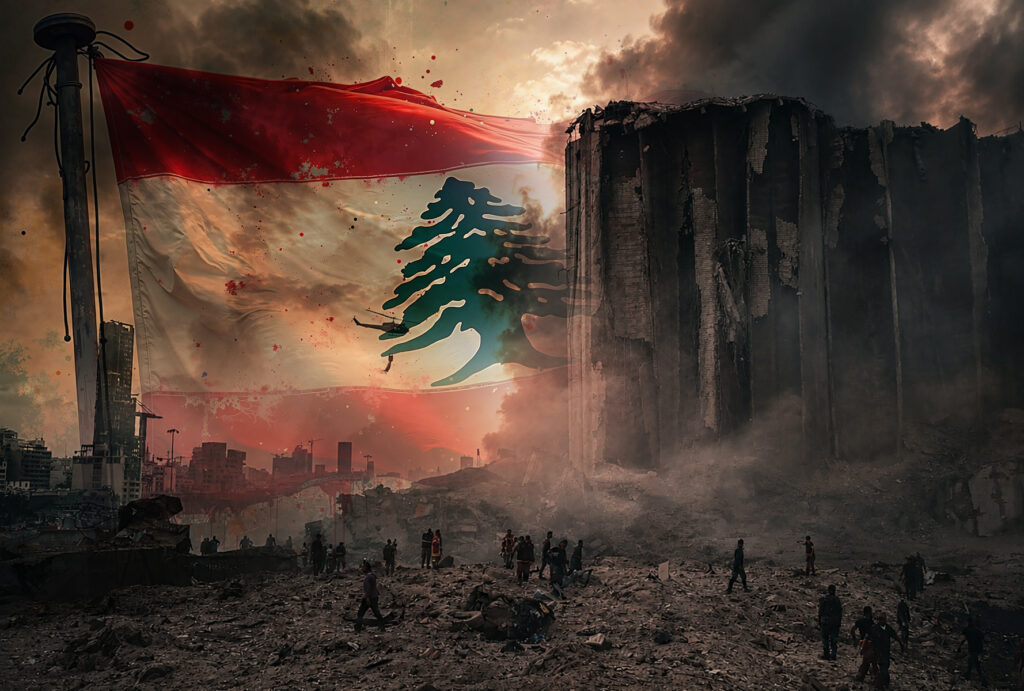

On 4 August 2020, one of the largest non-nuclear explosions in modern history devastated Beirut. A large quantity of ammonium nitrate, originating from a shipment of approximately 2,750 tonnes that had been stored for years in Hangar 12 at the Port of Beirut, detonated following a fire, causing catastrophic destruction.
The explosion killed at least 218 people, injured more than 7,000, displaced over 300,000 residents, and damaged tens of thousands of homes, businesses and public buildings across Beirut.
The explosion also exposed failures in port management, customs oversight and government decision-making. Six years later, the full chain of responsibility has not been established, and the Lebanese state has yet to provide victims and survivors with truth, justice, effective reparations and guarantees of non-recurrence.
The investigation repeatedly advanced and stalled as judicial decisions, immunity rules and political interference affected its course.
The Beginning of the Investigation
The Lebanese authorities opened a judicial investigation shortly after the explosion in August 2020, appointing Judge Fadi Sawan as the judicial investigator. In December 2020, Judge Sawan charged caretaker Prime Minister Hassan Diab together with former ministers Ali Hassan Khalil, Ghazi Zeaiter and Youssef Fenianos on allegations of criminal negligence connected to the explosion. The charges represented the first significant attempt to extend criminal responsibility beyond lower-ranking port officials to senior political figures.
However, on 18 February 2021, Lebanon’s Court of Cassation removed Judge Sawan after legal challenges filed by former ministers, who argued that he could not remain impartial. The following day, Judge Tarek Bitar was appointed to lead the investigation.
Challenges to a judge’s impartiality are a legitimate procedural safeguard. In this case, however, repeated removal requests interrupted the investigation as it expanded to include senior political figures.
Expanding the Investigation and Political Resistance
Throughout 2021, Judge Bitar broadened the investigation by seeking to question senior political, military and security officials. Among those he requested to question were former Prime Minister Hassan Diab, former ministers Ali Hassan Khalil, Ghazi Zeaiter, Nouhad Machnouk and Youssef Fenianos, as well as General Security Director Abbas Ibrahim and State Security Director Tony Saliba. Many of these requests required either parliamentary immunity to be lifted or prior administrative authorization.
Parliament declined to lift the immunity of sitting members of parliament, while requests to prosecute senior security officials were delayed or denied by the competent ministers. As legal challenges multiplied, political leaders increasingly accused Judge Bitar of selective justice and political bias. Together, parliamentary immunity, prior authorization requirements and repeated procedural objections resulted in successive suspensions of key investigative measures, significantly delaying the investigation’s progression toward indictment and trial.
Judicial Paralysis
By the end of 2021, the investigation had entered a prolonged period of paralysis. Former ministers and other defendants filed numerous lawsuits requesting Judge Bitar’s removal. At the same time, vacancies within Lebanon’s higher judiciary prevented the Court of Cassation from reaching the quorum necessary to rule on several of these legal challenges. The consequence was a near-complete suspension of the investigation for more than a year. The prolonged suspension also delayed victims’ access to truth, accountability and an effective remedy.
No senior political official was brought before trial, despite mounting evidence that multiple public authorities had received repeated warnings regarding the dangerous ammonium nitrate shipment before the explosion.
Throughout 2022, victims’ families continued organizing monthly demonstrations, commemorations and international advocacy campaigns demanding truth and accountability. They repeatedly called upon the United Nations Human Rights Council to establish an independent international fact-finding mission, arguing that the domestic investigation had become politically obstructed.
International human rights organizations, including Amnesty International and Human Rights Watch, similarly concluded that political interference had seriously undermined the independence and effectiveness of the investigation.
The Institutional Crisis of January 2023
After more than a year of suspension, Judge Bitar announced in January 2023 that he would resume the investigation based on his interpretation of Lebanese procedural law. He ordered the release of five detainees who had spent more than two years in pretrial detention without trial and brought additional charges against several senior officials, including then Public Prosecutor Ghassan Oueidat.
The response was unprecedented. Public Prosecutor Ghassan Oueidat declared Judge Bitar’s decisions unlawful, ordered the release of all remaining detainees, prohibited prosecutors and security agencies from cooperating with Judge Bitar, and initiated legal proceedings against the investigating judge himself.
The conflicting decisions issued by the investigating judge and the Public Prosecutor created a procedural deadlock that prevented the implementation of key investigative measures and brought the investigation to a standstill once again.
Victims’ Rights: Truth, Justice and Reparations
International human rights law requires states to conduct an effective investigation where state action or inaction may have contributed to serious harm. Victims and their families are also entitled to truth, justice, adequate reparations and guarantees of non-recurrence. The prolonged delays in the Beirut Port investigation therefore raise serious questions about whether Lebanon has met these obligations.
In the aftermath of the explosion, Lebanon adopted Law No. 196 of 2020 granting benefits to the families of victims comparable to those provided to families of military martyrs. Additional legal measures concerning damaged properties were introduced through Law No. 194 of 2020. Nevertheless, compensation remained limited, inconsistent and insufficient to reflect the scale of human suffering and economic loss. Much of the emergency assistance, reconstruction and social support instead came from Lebanese civil society organizations, international NGOs, United Nations agencies and foreign donors.
While emergency assistance may address victims’ immediate humanitarian needs, it cannot substitute for the state’s obligation under international human rights law to provide adequate, effective and prompt reparations for the harm suffered. Six years later, Lebanon has yet to establish a comprehensive reparations framework capable of addressing the full range of losses suffered by victims and survivors.
Reconstruction and Institutional Reform
The explosion exposed failures in the management of hazardous materials, coordination between public authorities and institutional oversight. Customs authorities, the port administration, judicial bodies, security agencies and successive governments received warnings about the ammonium nitrate over several years, yet no authority ensured its removal or neutralization. These failures also reflected wider problems in administrative coordination, judicial oversight and public accountability.
In response, the European Union, the United Nations and the World Bank launched the Lebanon Reform, Recovery and Reconstruction Framework (3RF), which sought to connect physical reconstruction with governance reforms and institutional accountability.
The framework supported housing rehabilitation, economic recovery, public services and governance initiatives. However, many of the institutional reforms identified following the explosion, including judicial reform, anti-corruption measures, public procurement reform and comprehensive port governance reform, remain incomplete.
Although much of Beirut has been physically rebuilt, many of the institutional reforms identified in the aftermath of the explosion, including those relating to judicial independence, port governance, customs oversight and public accountability, have yet to be fully implemented.
Renewed Momentum
In early 2025, prosecutorial authorities reversed the instructions that had prevented judicial bodies from cooperating with Judge Bitar. This allowed the investigation to resume after years of institutional obstruction.
In early 2025, Interim Public Prosecutor Jamal Hajjar revoked the instructions preventing judicial authorities from cooperating with Judge Bitar. On 16 January 2025, Judge Bitar resumed investigative activity by summoning additional military, customs, security and port officials for questioning. Questioning continued throughout 2025, marking the first sustained progress in the investigation since its suspension.
Closing the Investigative Phase
On 30 March 2026, Judge Bitar concluded the investigative phase and referred the case file to the Public Prosecutor at the Court of Cassation.
According to public reporting, the case file concerns approximately seventy defendants, including former ministers, judges, military officers, security officials, customs officials and port personnel.
The closure of the investigation does not constitute a finding of guilt or the conclusion of criminal proceedings. Rather, it signifies that the investigating judge considers the evidence-gathering phase complete, allowing the case to move toward indictment and eventual trial before the Judicial Council.
Six Years Later
Six years after the Beirut Port explosion, the investigation has resumed and reached a significant procedural stage. Judge Bitar has concluded the investigative phase and referred the case file to the Public Prosecutor at the Court of Cassation. Yet the central demands raised by victims and survivors remain only partially fulfilled.
No senior political official has been convicted in connection with the explosion. The full chain of responsibility has not yet been established through a final judicial decision. A comprehensive reparations program remains absent, and many institutional reforms intended to prevent similar disasters have yet to be fully implemented.
The case now tests whether Lebanon’s judicial institutions can complete a politically sensitive accountability process without renewed obstruction. The resumption of the investigation is significant, but no final determination of responsibility has yet been reached. The next stage will depend on whether prosecutors and the Judicial Council can proceed independently and without political interference.
For victims and survivors, the investigation will matter only if it establishes responsibility through fair and independent proceedings, provides effective reparations and leads to institutional reforms addressing the failures exposed by the explosion.