Digital Rights & Civic Tech
Defending free expression and privacy online, exposing surveillance and digital authoritarianism, and equipping civil society with the tools to operate safely in the region.
Why digital rights are human rights
The MENA region has become a laboratory for digital authoritarianism. Spyware purchased from democracies is repurposed against journalists. Encryption laws are weaponized. Platforms over-moderate Arabic content while leaving incitement against activists in place. The internet shutdown is now a routine tool of state response.
HuMENA tracks surveillance markets and infrastructure, documents platform-governance failures, and trains civil society in operational security, connecting on-the-ground evidence to policy windows in Brussels, Geneva, and Washington.
Our work intersects every other area: defenders, civic space, refugees, women, minorities. The digital layer is where repression scales the fastest.
How HuMENA works on digital rights & civic tech
Online expression
We follow prosecutions for social media posts and online writing, including cases brought under Tunisia’s Decree 54.
Surveillance and censorship
We document state surveillance of defenders and the blocking of news websites, as in our report on surveillance in Jordan.
Platforms and the UN
We call out platforms that restrict the accounts of rights groups, and raise digital rights at the UN Human Rights Council.
Recent reports & analyses
9 October 2026 · Statements
Tunisia | Article 24 Reform Leaves Questions of Justice Unanswered
HuMENA calls for a review of the situation of detainees and convicted people, data on the amendment’s impact and redress for previous convictions.
Read publication →
3 September 2026 · Analysis
From Criticism to Crime: How Tunisia Uses Article 86 Against Dissent
Freedom of expression in Tunisia faces another test, as courts keep sentencing people under Article 86 of the Telecommunications Code.
Read publication →
3 September 2026 · Analysis
The Media Law in Lebanon: Between Opportunities and Risks
After more than sixteen years of discussion, Lebanon’s parliament adopted a new media law on 11 August 2026.
Read publication →
22 June 2026 · Guide
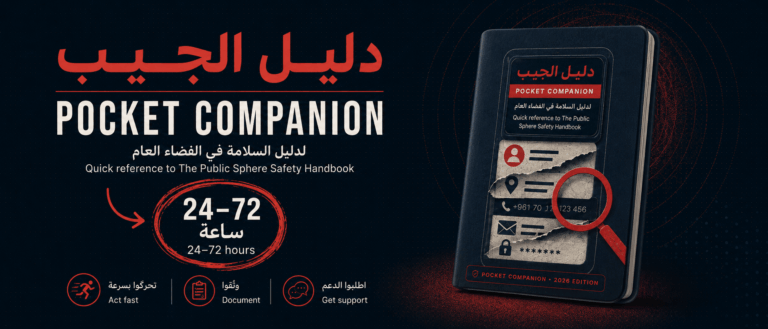
Public Sphere Safety Pocket Handbook
When a digital attack begins, time is rarely on the side of the person facing it. The first hours move quickly, and decisions made in them can be hard to undo later, from deleting content that could…
Read publication →More recent work
- Public Sphere Safety Kit: Practical Tools for Safer Civic Life in LebanonToolkit
- Criminalizing Truth: Gulf Governments Must End the Crackdown on InformationJoint Statements
- Meta blocks human rights accounts from reaching audiences in Saudi Arabia and the UAEJoint Statements
- Tunisia | The Verdict Against Zied El-Heni: How Tunisia Is Criminalizing Journalistic Expression A legal reading of Article 86, Law-Decree 54, and the sidelining of Tunisia’s press law safeguardsLegal & Political Analysis
- Tunisia | HuMENA Condemns the Imprisonment of Journalist Zied El Heni and Calls for the Verdict to Be AnnulledStatements
- HuMENA at HRC61: Advocacy on Digital Rights and Civic Space in MENANews
Stay close to the work. Get our briefings on digital rights and civic tech in MENA.