
Alaa
Abdel Fattah
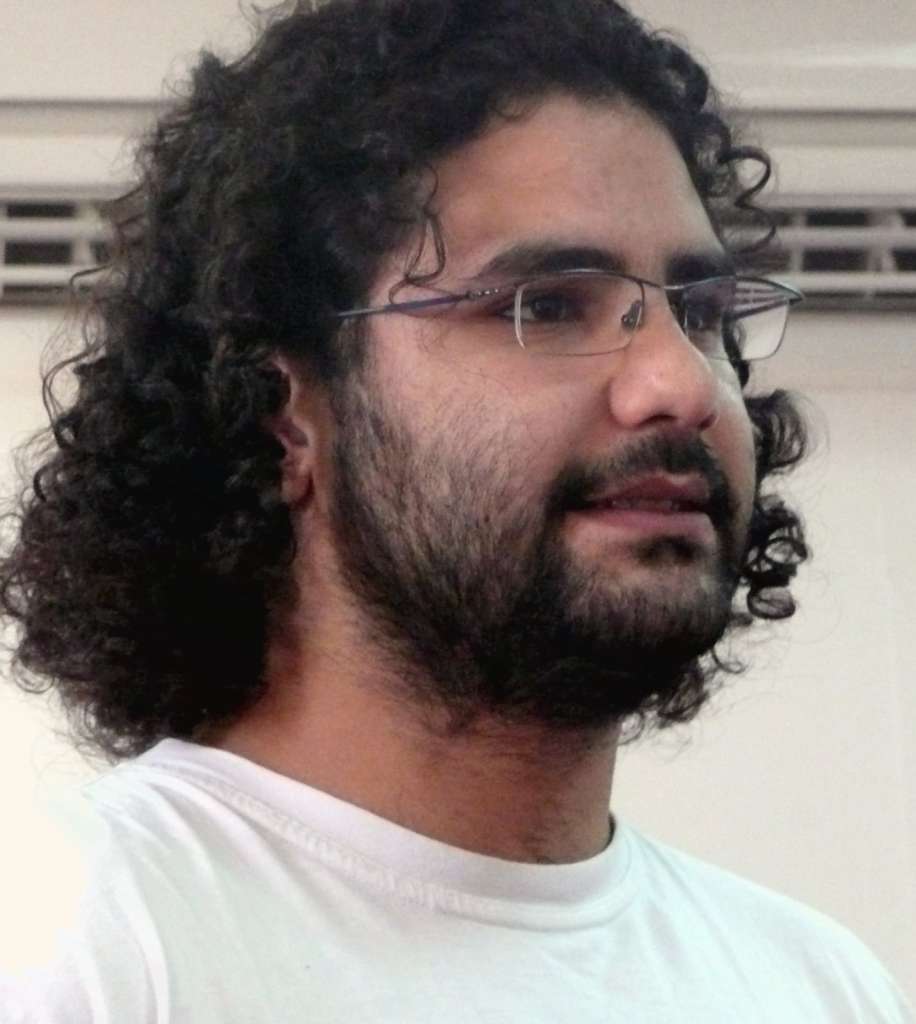
Alaa Abdel Fattah, a blogger and digital rights defender, was arrested in 2019 while complying with probation conditions. He was held in solitary confinement in Tora High Security prison 2 in dire conditions and denied family letters, until his release in September 2025.
- Country
- Egypt
- Role
- Blogger / online writer
- Arrested
- 29 Sep 2019
- Sentence
- Five years in prison for spreading false news (Emergency State Security misdemeanour court, 20 December 2021, no appeal possible); pardoned on 22 September 2025.
- Status
- At liberty
- Arrested
- 29 Sep 2019
- Sentence
- Five years in prison for spreading false news (Emergency State Security misdemeanour court, 20 December 2021, no appeal possible); pardoned on 22 September 2025.
- Judicial status
- Pardoned
- Name in Arabic
- علاء عبد الفتاح
- Charges
- Belonging to a terrorist group (accusation in the 2019 investigation)
- Funding a terrorist group (accusation in the 2019 investigation)
- Spreading false news undermining national security (convicted on 20 December 2021)
- Using social media to commit publishing offenses (accusation in the 2019 investigation)
The cases, as we document them.
Where a case was replaced by a new one, the two are linked.
- Case1356/2019
Defendant
Supreme State Security Prosecution
Also named in this case: Mohamed Ibrahim (known as “Oxygen”)
- Case1781/2019
The arrest, and what followed.
Update, 13 May 2026: Abdel Fattah was released by presidential pardon on 23 September 2025 after almost six years of imprisonment. His mother Laila Soueif had sustained a long hunger strike to protest his continued detention. In December 2025 his travel ban was lifted, and on 26 December he moved to the United Kingdom to reunite with his family.
Background and Work
Alaa Abdel Fattah is a software developer, blogger, and one of Egypt's most recognized digital rights defenders. He co-founded the Egyptian Blogger Network and developed online platforms that enabled Egyptians to share information and organize during periods of heightened repression. His technical skills and commitment to free expression made him a key figure in the country's early digital activism.
He became a prominent member of the "No to Military Trials for Civilians" movement, which documented and challenged the military judiciary's prosecution of civilians. His activism spanned more than a decade and included advocacy on torture, police brutality, and freedom of assembly. He was a vocal critic of successive governments, including under Mubarak, the Supreme Council of the Armed Forces, Morsi, and Sisi.
He was jailed under each of them. He was held for several weeks in 2006 after a protest for judicial independence, and from October to December 2011 over the Maspero events. Arrested in a raid on his home in November 2013 after a protest against military trials, he was sentenced in absentia to 15 years in June 2014 and, on retrial in February 2015, to five years in prison and five years of probation. He was released on 29 March 2019 and had to spend his nights at a police station under probation.
The Arrest
On 29 September 2019, Alaa was arrested at the Dokki police station where he was fulfilling his daily twelve-hour probation requirement. He had been on supervised release following a previous conviction. His arrest came amid a broader crackdown following small protests in Cairo and other cities earlier that month.
Later the same day, his lawyer Mohamed El-Baqer, who is also the Director of the Adalah Center for Rights and Freedoms, was arrested at the State Security Prosecution premises while attending an investigation session with Alaa. Both men were charged under Criminal Case 1356 of 2019 with belonging to a terrorist group, funding a terrorist group, spreading false news undermining national security, and using social media to commit publishing offenses. They were remanded in pre-trial detention at Tora High Security prison 2.
Detention Conditions and Health
Alaa was held in solitary confinement in Tora High Security prison 2 after his arrest. The conditions were severe. He was denied access to books, time in the prison yard, a radio, warm clothing during winter months, a mattress, and adequate ventilation in his cell. His family was repeatedly denied the weekly letter that Egyptian law mandates prisoners be allowed to send.
On 13 September 2021, Alaa did not appear at a hearing where his pre-trial detention was renewed for a further 45 days. He was later able to meet with a judge and his lawyer, to whom he described severe distress. At that point, he had been in solitary confinement for nearly two years with no trial date set.
Legal Proceedings
Since their arrest, both Alaa and Mohamed El-Baqer have had their pre-trial detention renewed repeatedly by the Supreme State Security Prosecution and the Cairo Criminal Court. The renewals continued without substantive legal justification and without a trial being scheduled. The practice of indefinite pre-trial detention has become a standard tool for Egyptian authorities to detain activists and critics without conviction.
On 19 November 2020, the Cairo Criminal Court placed Alaa and Mohamed El-Baqer, along with twenty-seven other activists, on Egypt's terrorist list for five years. The court alleged that they had joined the banned Muslim Brotherhood, a charge used broadly against dissidents. The ruling imposed a travel ban and asset freeze for three years. The court also added both men to a new case, State Security Case 1781 of 2019, but the charges in that case have not been disclosed.
International Response
Alaa Abdel Fattah's case has drawn sustained international attention. Human rights organizations have called for his immediate release and condemned the Egyptian government's use of counter-terrorism law to silence peaceful dissent. His detention was part of a broader pattern in Egypt in which pre-trial detention, enforced disappearance, torture, and judicial harassment are used systematically against activists, journalists, lawyers, and civil society members.
His case illustrates the Egyptian state's strategy of using vague national security charges and renewable detention orders to bypass the need for trial or conviction. The addition to the terrorist list and the imposition of asset freezes and travel bans further isolate defenders and their families, compounding the punitive effect of detention itself.
-
Sibling
Sanaa Seif
“Her brother, Alaa Abdel Fattah, is a blogger and founding member of the "No to Military Trials for Civilians" movement.”
-
Named in this file
Mohamed El-Baqer
“His lawyer, Mohamed El-Baqer, went to the State Security Prosecution premises that same day to attend the investigation session.”