
Egypt after the Rabaa Massacre: Ten years of repression, collective punishment, and impunity
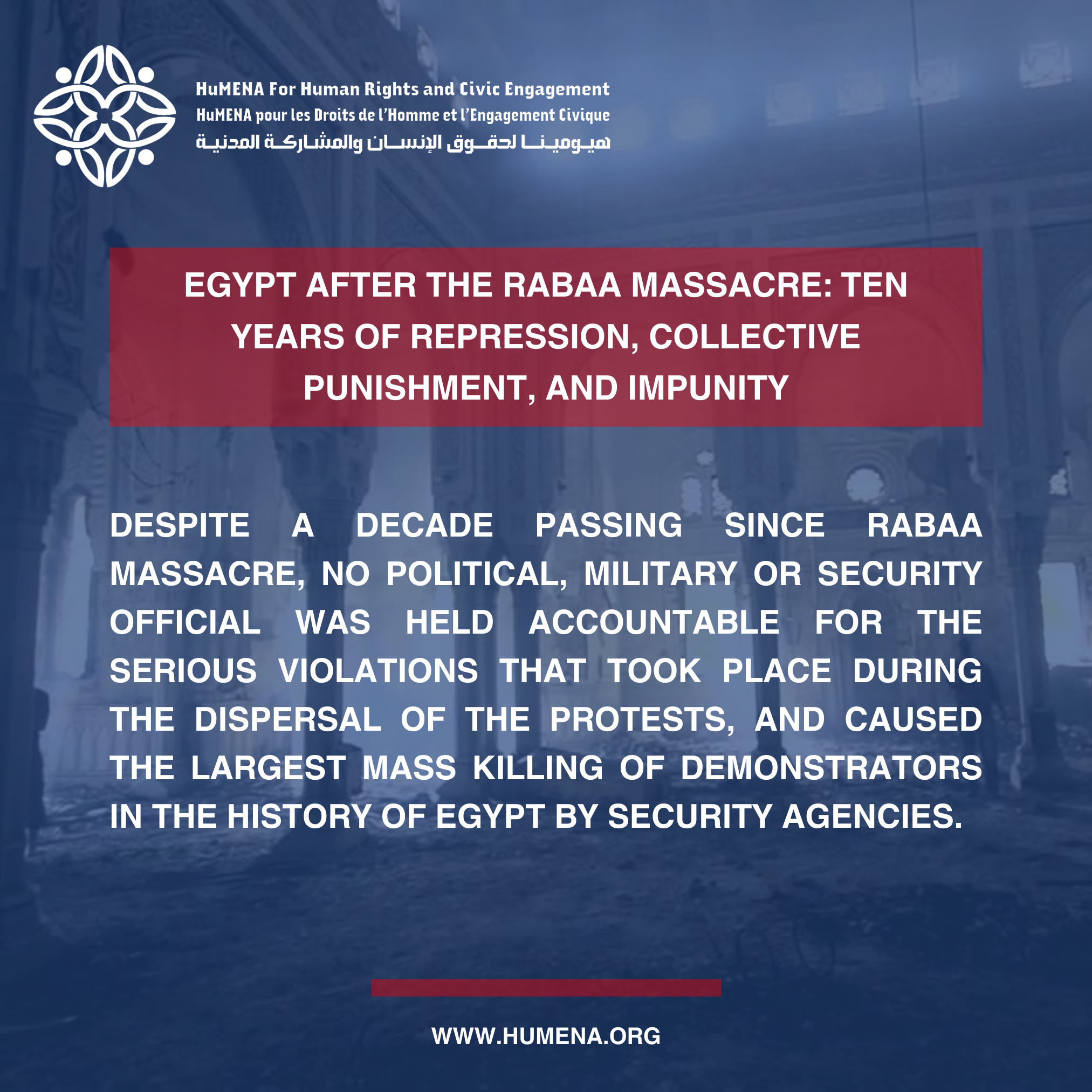
In commemoration of the tenth anniversary of the Rabaa massacre, 26 organizations express their condolences to the families who lost loved ones peacefully opposing the overthrow of former President Mohamed Morsi and reiterate their calls for accountability and justice. A decade ago, on August 14, 2013 under the direct orders of Egypt’s current president – then Minister of Defense – Field Marshal Abdel Fatah El Sisi, Prime Minister Hazem El Beblawi, and interim President Adli Mansoor, Egyptian security forces and military officers killed more than 817 people during the forceful dispersal of the Rabaa and Nahda sit-ins in Cairo. No political or military official has been held accountable for the largest massacre by security officers in the country’s history. The undersigned organizations call for an international investigation into those responsible for the massacre and that they are held legally accountable for their crimes.
The indiscriminate and mass killings that occurred between July and August 2013 by Egyptian security forces reached their apex in the Rabaa and Nahda massacres, resulting in the killing of hundreds of protesters, including women and children. The massacres subsequently resulted in the darkest episode of repression in the country’s history. The security apparatus continues to surveil and repress Egyptians with impunity. There is little to no access to participatory democracy. Political opponents, human rights defenders, journalists, and intellectuals are under constant threat of arbitrary detention, enforced disappearance, torture, and even extrajudicial killings. The signatories demand an end to all ongoing violations of human rights and a start to a process of reparations for the victims and their families.
On July 3, 2013, in the aftermath of popular protests demanding an early election, the military overthrew Mohammad Morsi, the first-ever elected president under free and fair conditions and a leader in the Muslim Brotherhood. As a result, tens of thousands of Morsi’s supporters conducted large-scale sit-ins and protests in Cairo, Giza and around the country.
In the weeks and months that followed, the Egyptian government violently ended opposition to their military coup by firing indiscriminately on peaceful protesters and detaining tens of thousands of survivors and their families. Detainees were subject to mass trials and systematically denied due process and basic legal principles. These trials resulted in mass death sentences and lengthy prison periods.
Violations extended to citizens from across the political, religious, and social spectrums. The Egyptian government designated thousands of citizens as terrorists and issued formal and informal travel bans under sham pretenses. Hundreds were tried in military and specialized emergency courts where they were denied access to cassation courts. Authorities have also systematically violated its constitutional commitments, pretrial detention laws, and prison bylaws. Thousands of detainees remain in pretrial detention, exceeding the legal maximum of two years, many of them recycled into new cases with the same accusations to continue their detention, where detainees are denied visits and basic needs such as medicine, food, toiletries, and books.
In the last ten years, Egyptian human rights organizations have recorded the enforced disappearance of no less than 3,000 citizens for varying periods of time, death by mistreatment and medical negligence of at least 1,200 people in detention centers, the sexual assault of at least 655 people and their family members, and the extrajudicial killing of more than 750 people.
Since the Rabaa massacre, the government has used different state entities, including the judiciary, interior ministry, and military (even state institutions, universities, and schools) to surveil and punish political opponents and citizens critical of the government. Since the massacre, no one has been immune from the state’s violence. Citizens have been arbitrarily detained, families of dissidents have been taken as hostages, prisoners have been tortured, citizens in Sinai have been displaced from their homes for ‘security concerns’, Coptic Christians have been detained for belonging to terrorist organizations, people have been forcibly disappeared for what they write on social media, websites of news agencies and human rights organization have been blocked, bookstores and publishers are shut down under the guise of national security, journalists have been targeted for doing their job, young women have been detained for ‘violating family values’, intellectuals and academics are persecuted, subjected to military trials, and could be killed for their research, and members of the LGBTQ community are tortured inside police stations. In post-Rabaa Egypt, perpetrators not held accountable.
The newly-announced initiatives of the Egyptian government–such as declaring a national human rights strategy, activating a committee for the presidential pardon for detainees, or initiating a national dialogue involving various political and social actors–are only superficially reformist and have not had any real social or political success for the Egyptian public. From April 2022 to May 2023 the number of political prisoners released includes approximately 1,400 individuals, however, human rights organizations have recorded that in that same period, more than 3,700 people have been arbitrarily detained. These figures are a testament to the lack of political will to systematically address human rights concerns.
The way forward for the public and the future of Egypt lies in the government’s release of all political prisoners, compensation of the victims, and acknowledging its complicity in the massacre. Holding the perpetrators accountable is essential to move past the bloodshed and the subsequent attacks on participatory politics, citizenship, civil society, and overall freedoms in Egypt.
Signatories
-
ACAT-France
-
Association for Freedom of Thought and Expression (AFTE)
-
CAFAGB
-
Cairo Institute for Human Rights Studies (CIHRS)
-
Citizens International
-
Committee for Justice
-
DIGNITY – Danish Institute against Torture
-
Egyptian Commission for Rights and Freedoms (ECRF)
-
Egyptian Coordination of Rights and Freedoms
-
Egyptian Front for Human Rights (EFHR)
-
Egyptian Human Rights Forum (EHRF)
-
Egyptian Initiative for Personal Rights (EIPR)
-
EgyptWide for Human Rights
-
El Nadim Center
-
El Shehab for Human Rights -SHR – LONDON
-
EuroMed Rights
-
HuMENA for Human Rights and Civic Engagement
-
International Service for Human Rights (ISHR)
-
Najda for Human Rights
-
Project on Middle East Democracy (POMED)
-
Refugees Platform in Egypt (RPE)
-
Sinai Foundation for Human Rights
-
Stop Enforced Disappearance Campaign
-
Syrian Network for Human Rights (SNHR)
-
The Freedom Initiative
-
Till The Last Prisoner
Media enquiries: info@humena.org
New publications, by email
Concise briefings on new HuMENA research, statements, and advocacy.
Subscribe