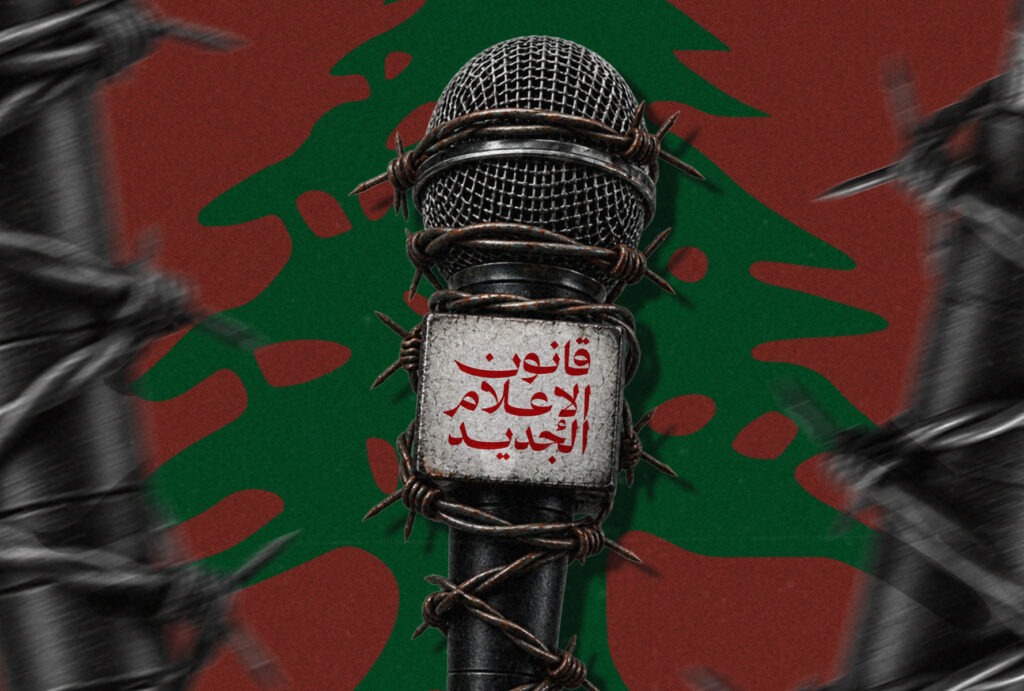
In Lebanon, after more than sixteen years of discussions in the parliament, the new media law was adopted on the 11th of August 2026. The 1962 Publications Law, its 1977 amendment under Legislative Decree 104, and the 1994 Audiovisual Media Law are mostly repealed and combined into a single framework that covers print, broadcast, and, for the first time, digital and electronic media under a single law. It reorganizes the way publication-related offenses are handled, transferring the majority of them from criminal to civil courts and doing away with pretrial detention for media-related offenses entirely. It also establishes a new National Media Authority to license and regulate the industry, replacing licensing functions previously divided between the Ministry of Information and the National Audiovisual Council.
The adoption was followed by controversies and several discussions over whether it is a step towards the independence of journalism, or further restrictions on the freedom of expression and media freedom. The law shifts many publication offences to civil liability, but Article 104(b) keeps imprisonment for vaguely defined false information. To understand the media law and the debates concerning it, the law should be situated in a historical, political and legal overview.
Historical Overview: the law(s) in the making
According to the book “The Lebanese Media: Anatomy of a System in a Perpetual Crisis”, Lebanon’s first press laws were enacted in 1909, during the Ottoman era. As Arab nationalism grew between 1908 and 1914, Beirut saw the founding of over sixty newspapers. After three revisions, the law remained in force until 1924, when a new, more oppressive law was enacted under the French Mandate. A number of laws were passed during the post-independence period, culminating in the Press Law of 1962, which was in effect until the new law was passed. The 1962 law underwent multiple revisions. Decree 104, which was issued in 1977, was one of those amendments that aimed to punish editors and journalists for publishing content that could offend the President of the Republic, foreign leaders, confessional organizations, or compromise state security.
The Audiovisual Media Law 382/94 governed broadcasting in Lebanon. Chapter III, Article G of the Ta’if Accord demanded that the media be reorganized following the end of the Lebanese civil war in 1990. Limiting the numerous unlicensed radio and television stations was the specific goal. In order to distribute audiovisual licenses, the National Audio-Visual Council (NAVC) was established. Following the civil war, the “media cake” was divided along sectarian lines, revealing the country’s power disparities. Each licensed broadcast media outlet has direct ties to political or sectarian organizations, making the system blatantly politically parallel. This is mainly related to how Lebanese broadcast media evolved during the civil war, when these channels were established to cater to the opposing parties and eventually came to represent the “partisan geography with each radio or television station serving a certain area and its respective audience.”
Political Overview: who owns the media?
From the historical overview briefly explained, the media is intertwined with the political sphere. The media is influenced by monopoly and sectarian divisions.
As per statistics published in 2024 by the Media Ownership Monitor Lebanon, Lebanon produces over 1,500 weekly and monthly periodicals and ten privately owned daily newspapers in three languages, making up roughly half of all periodicals in the Middle East. There are also roughly forty radio stations and nine television stations. Despite this diversity, more than 84% of the media outlets that are covered have political affiliations. Of them, 27% have direct ties to political parties, 5% have direct ties to the government, and about 60% are outlets affiliated with people who have participated in politics or hope to do so. Furthermore, at least eight of Lebanon’s most well-known families control about 32% of the country’s most well-known media outlets. This intertwining relationship between media outlets and power creates further confusion about the true definition of “media independence” and “media freedom”.
Legal Analysis: strengths and gaps in the law
- Ownership
Three days before the joint committees finalized the bill, on July 7, 2026, a Maharat Foundation study revealed that the main anti-concentration mechanism under discussion was a direct carryover from the 1994 Audiovisual Media Law: a hard cap that limited any one individual to no more than 10% of the shares in a company that owned an audiovisual outlet. A share-percentage cap alone would be insufficient regardless of where the threshold was set, according to legal experts consulted at the time, including former MP Ghassan Moukheiber, the bill’s original architect, and comparative media-law specialist Marius Dragomir. This is because effective control can be exercised through shareholder agreements, board composition, or financing arrangements that never appear in a share registry.
The adopted law does not include that 10% cap. Instead of a percentage-of-shares threshold, Article 7 places a structural cap on the number of outlets by restricting ownership to one radio and one television institution per person. None of the alternative or supplementary safeguards proposed during the committee debate, such as an audience-share test similar to the one Germany uses instead of a pure ownership threshold, examination of shareholder agreements or board control, or a specific method for identifying beneficial owners behind corporate or nominee structures, made it into the final text. The only mention of the underlying problem is in Article 45, which directs the Authority to take into account ‘concentration of ownership’ as one of a number of factors in developing its licensing plan. This is a question of planning judgment, not a hard test applied to particular forms of ownership.
The family-aggregation rule was kept and, in one way, reinforced. For the purposes of the cap, Article 8 treats a person’s spouse, ascendants, descendants, the spouses of those ascendants and descendants, and in-laws as a single owner; this is a broader net than its predecessor from 1994, which only counted a spouse, ascendants, and minor children. The cap on foreign ownership of media outlets that broadcast political programming is 20 percent of the capital. Separately, Articles 15-19 create a public registry of ownership and income sources for outlets, requiring disclosure of named owners, any shareholder with more than 5% and income sources including loans and donations. This is a genuine, if incomplete, transparency mechanism that functions independently of Article 8’s ownership cap rather than as a means of enforcing it.
As enacted, the law appears not to address existing concentration of ownership, In the same way that Article 51 expressly grandfathers current broadcast licenses for the remainder of their term, the caps are framed prospectively, governing how shares may be held going forward. The text is silent on whether an owner who already exceeds the new limits must divest. This silence matters as according to Media Ownership Monitor Lebanon (2024), twelve families appear to be the owners of over one-third of the outlets surveyed, and every covered television and print outlet as well as the vast majority of radio stations are already directly connected to the state, to current or former officials, or to political parties. No matter how it is drawn, a structural cap of this type only affects how the subsequent share transfer occurs; it does not, by itself, unwind concentration that existed before it. The question of whether the Authority’s oversight powers and the funding-disclosure registry can accomplish what the ownership cap cannot depends entirely on how independently the Authority is willing to use them.
- What the Law Reformed
In comparison with the legal framework it replaces, the 2026 law creates substantive changes which are worth mentioning. For instance, digital media was recognized for the first time and it now has a dedicated legal basis. Articles 61 to 64 differentiate professional electronic media outlets from personal blogs and general online expression. Establishing an electronic platform requires no prior authorization at all, however, establishing a professional digital outlet takes on the same disclosure obligations as print, which are the provision of a named owner, a registration number with the authority, a responsible director meeting defined qualifications. Broadcast also remains subject to licensing. According to the explanatory memorandum of the law, this closes a gap in previous laws as courts had been applying inconsistent standards to digital and print publishers for materially similar conduct, as only one of them had a clear legal framework to regulate, according to the explanatory memorandum of the law.
Another reform evident in the new law is the source protection. Article 116 covers not only compelled testimony but also the search, seizure, and surveillance of devices and records; it only permits compulsion by reasoned court order, and only in cases where there is an imminent threat to life or confirmed terrorism prevention. It also extends beyond journalists to anyone who learns the identity of a source through a professional relationship with them.
Additionally, the law establishes Lebanon’s first National Media Authority, a body with its own legal personality and financial independence, ten members who are primarily elected by professional and judicial bodies rather than appointed by the government, six-year terms that are not renewable, and immunity from arrest or prosecution while in office without the Authority’s approval. On paper, this represents a significant structural shift away from ministerial sector oversight. The independence of the authority itself can be examined through the processes of appointment and removal of its members, and the allocated budget for it. Both removal and appointment are genuinely free from regular executive control. Seven of the ten members of the Authority are directly elected by professional and judicial bodies, including the judiciary, bar associations, media faculties, and national human rights and anti-corruption commissions. The remaining three members are appointed by Cabinet solely from candidate lists created by those same bodies, and they all serve six-year terms that are not renewable in accordance with Articles 74 and 75. According to Article 83, the Council of Ministers is expressly prohibited from suspending or stopping the Authority’s operations in any situation, including emergencies. Removing a member necessitates a two-thirds Cabinet vote, which is only activated after a panel composed of the heads of the Supreme Judicial Council, the State Council, and the Court of Audit confirms one of four specific grounds. Budget independence is more qualified: the Authority manages its daily expenditures through a separate account, but the size of that budget is determined by the regular state budget process, which is created by the Authority and then sent to Cabinet via the Ministers of Information and Finance. This gives the executive actual control over its resources, despite the fact that its seated members are hard to remove.
- Wins and Losses in the Restrictions of Media Freedom
The law introduced several wins in alleviating the restrictions on freedom of expression. The 1943 Penal Code defined defamation as “attributing something to someone, even by way of doubt or a question, that harms their honor, dignity, or reputation” and contempt/insult as “expression revealing belittlement of a person without an actual accusation.” The new law does not eliminate these categories. Articles 385 through 389 of Legislative Decree No. 340/1943, which cover defamation, insult, and disparagement, as well as previous false-news and religious/national-sentiment offenses, are covered by Article 105, which is more specific and narrower. However, it only applies to the conduct that this law itself regulates: expression through the media it covers. Article 105 makes it clear that these Penal Code provisions “remain in force” for anything outside of that scope and that, in cases where the two bodies of law clash, the new law only takes precedence as a special law that qualifies a general one, not as a repeal of it. While Article 105’s treatment of the Penal Code articles is a more limited, scope-limited carve-out rather than an abolition, Article 119 of the same law does completely repeal three earlier instruments using different statutory language.
In actuality, this results in the coexistence of two parallel systems. Article 107 defines contempt and insult committed through media covered by this law as civil matters, which are litigated as quasi-delicts under the Code of Obligations and Contracts in the special civil chambers established by Article 111. The 1943 Penal Code, which has not been amended, still governs the same behavior that occurs outside of a media setting, such as regular interpersonal insults or defamations that have nothing to do with publication. Furthermore and regardless of the accused’s occupation or capacity, Article 114 forbids pretrial detention for any offense committed through any media or electronic means covered by the law. This prohibition is more expansive than a journalist-specific shield because it applies to everyone.
However, the law created new restrictions with Article 104 allowing for imprisonment of every person over broad charges such as publishing news containing fabrication, malice, and falsity. Under the heading “Incitement to Hatred and Discrimination (and False News),” Article 104 establishes two separate offenses, and a third clause aggravates both if they result in significant harm. The clause that is most pertinent to discussions about press freedom. According to the Article, anyone who willfully creates false information and disseminates damaging news faces a maximum sentence of three months to three years in prison, a fine of five to fifteen times the minimum wage, or both.
Courts have three options under the penalty structure: imprisonment alone, a fine of five to fifteen times the minimum wage, or both. If the underlying acts cause death, serious injury, or substantial property destruction, paragraph (c) elevates this to al-ashghal al-shaqqa, or hard labor, a more severe penalty tier under Lebanese criminal law.
There are two aspects of scope that are both textual and directly related to the “every person” point: first, paragraph (b) refers to “any person” and makes no mention of journalists, media professionals, or registered media organizations. Second, and less evident, the incitement offense in paragraph (a) expressly restricts its scope to acts carried out “using any means of publication or media provided for in this law”; however, paragraph (b) lacks a comparable restriction. The law’s definition of non-professional electronic media in Article 61(b) includes personal blogs and individual expression online, so it is clear that the false-news offense is not textually limited to professional publishing at all. It appears capable of plausibly reaching ordinary social media activity as much as institutional journalism.
In terms of legality, General Comment No. 34 mandates that a restriction on expression “be formulated with sufficient precision to enable an individual to regulate his or her conduct accordingly” and not “confer unfettered discretion” on those enforcing it (para. 25) when this article is evaluated against the tripartite test for permissible restrictions on expression under Article 19(3) of the ICCPR. None of the terms “fabrication,” “false,” and “harmful” that are used in Article 104(b) are defined anywhere in the law, including in the definitions provided in Article 1. This stands in stark contrast to paragraph (a) of the same article, which bases liability on six cumulative factors: social and political context, the speaker’s standing, intent, content and form, reach, and likelihood of resulting harm. These factors closely resemble the six-part threshold test the UN human rights office established in the 2012 Rabat Plan of Action for incitement offenses under ICCPR Article 20(2). While paragraph (b) shares the same penalty range, it lacks the safeguards of paragraph (a) which is the clearest asymmetry of the Article 104.
Restrictions may only be placed on legitimate grounds such as national security, public order, public health, morality or the rights or reputations of others (Article 19(3)). This gap was directly addressed by the four UN and regional special rapporteurs on freedom of expression in their 2017 Joint Declaration on Freedom of Expression and “Fake News,” in which they warned that broad, vague prohibitions on the dissemination of false information may be invoked to stifle legitimate criticism rather than to further any of the goals enumerated in the Covenant.
In terms of necessity and proportionality, the Court finds that, although there is a legitimate interest in preventing damaging falsehoods, the law already provides a narrower remedy for this precise injury: Articles 98–103 establish a right of correction and reply, requiring the dissemination of a correction free of charge and without undue delay. A crime punishable by a maximum three years’ imprisonment, plus an existing civil remedy for the same underlying conduct, is difficult to characterize as the least restrictive alternative.
Furthermore, in a wider pattern in Lebanon, the penalization of defamation in the past years was accompanied by an increase of the number of defamation cases investigated. Established in 2006, the Cybercrimes Bureau investigated 3,599 cases related to defamation, libel, and slander from 2015 to 2019, three cases of which received prison sentences, according to Human Rights Watch. This pattern also raises concern under Article 19 of the ICCPR, which protects the fundamental right of freedom of expression and opinion and requires any restriction on expression to be provided by law, serve a legitimate aim, and be necessary and proportionate.
In a country with a long history of weaponizing law to restrict freedom of expression, further penalization of vague and obscure charges is considered dangerous to the overall media freedom.
After sixteen years of stalled reform, a media law that reduces criminal defamation within the media scope while creating further criminal charges for fabrication and malice content is a law that takes a step further then immediately takes the same step back. The defamation crime and the fabrication one are equally broad charges open for weaponization by political powers. It is urgent to amend Article 104 to end the carceral punishment for journalists and all individuals engaged in publishing. The real gains of the law, such as the abolition of pretrial detention and the transfer of defamation and insult cases from criminal to civil courts, are significant and should not be written off as purely decorative. They are real and —hopefully effective— in creating a freer sphere for expression. Yet, to reintroduce carceral punishment on vague and undefined charges is to reopen the door for arbitrary detention and the penalization of freedom of expression. Furthermore, the law should attempt to change the current status-quo when it comes to the ownership concentrated among a few to most media outlets. While the law creates caps for the upcoming media outlets and future share transfer within current media outlets, it does not treat the current situation retrospectively, lessening the context-sensitive measures the law should have taken to reduce the politicization and sectarianization of media.